

Consensus
Search scholarly papers for a question, compare their findings, and follow the evidence back to its sources.
Sources checked 4 October 2026.

PlansFree; from US$20/mo Monthly or annual US plans
- Free
- Free
- Unlimited paper searches; 10 Pro messages, 3 Deep reviews, and 10 Study Snapshots per month.
- Pro
- US$20/month
- Public individual monthly rate; unlimited Pro messages, 15 Deep reviews, and unlimited Study Snapshots per month.
- Pro annual
- US$144/year
- Billed annually (US$12/month equivalent); same Pro allowances.
- Deep
- US$65/month
- Public individual monthly rate; 200 Deep reviews and unlimited Pro messages and Study Snapshots per month.
- Deep annual
- US$540/year
- Billed annually (US$45/month equivalent); same Deep allowances.
Teams and Enterprise plans use custom pricing.
View current plans (opens in a new tab)AI & setupAI includedAccount sign-in
Sign in to use the web app. Full-text chat works across specific papers, Collections, and documents you upload.
Where it worksWebBrowser-based
Search and analysis run through the Consensus website.
Usage & termsMonthly analysis allowancesSome analyses use abstracts
AI can misread a real paper; verify important claims in the cited source.
A citation without a full-text checkmark used the abstract and available metadata.
Study Snapshot fields may be missing when the abstract does not report them.
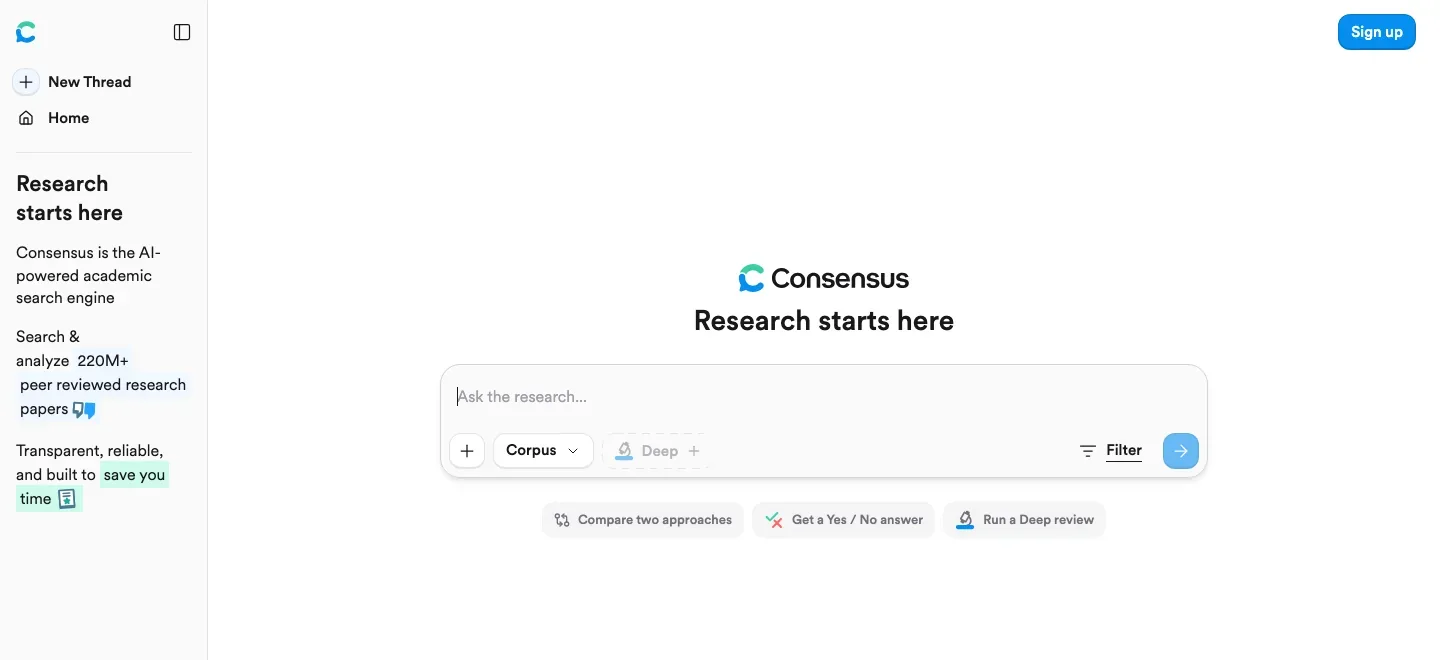
Question-led scholarly search
Search by the meaning of a question
Consensus combines semantic and keyword search across paper titles and abstracts, then ranks results using relevance and signals such as publication date, citation count, and journal quality. Search filters can narrow the results further.
The search covers scholarly papers rather than general web pages.
Pro messages and Deep reviews
Compare findings across a focused set of papers
Pro messages summarize findings from the top papers in a search and can analyze up to 20 papers. Deep reviews analyze up to 100 for a more structured account of the evidence.
Citation trail
Trace a claim to the passage behind it
Hover over an in-line citation to see the exact quote used in that part of the analysis, then open the source paper to check its context.
A checkmark shows that Consensus used the full text; without one, it relied on the abstract and available metadata.
Tools for checking and organizing papers
-
Follow up on a paper while keeping the research context
-
Ask questions across the full text of a paper, a Collection, or an uploaded document. Threads keep follow-up questions within the same search, which helps investigate a study's methods and findings while staying with the source material.
-
Check what a study measured before you cite it
-
A Snapshot extracts details such as a study's population, sample size, duration, location, methods, outcomes, and results into a quick summary. Use those details to judge whether a paper matches the question you are researching.
A field may be blank when the paper's abstract does not contain that information.
-
See where findings agree and where gaps remain
-
For suitable yes-or-no questions, the Consensus Meter visualizes whether research leans toward, against, or is mixed on a claim. Analyses can also use Claims & Evidence tables, Research Gaps Matrices, result timelines, and figures or tables from cited open-access papers to organize the source material.
Available views depend on the question, analysis type, and papers retrieved; figures and tables require available open-access papers.
-
Keep a reading list and move citations into reference tools
-
Save papers in custom lists, revisit search history, and export citations to Zotero, EndNote, or Mendeley.
Feature details & official sources
Purpose and capability information checked 4 October 2026.
Platform and pricing reference: 24 October 2026.
Recorded requirements and limits
- Create an account; AI analysis and Deep reviews have plan-dependent monthly allowances.
- A citation without a full-text checkmark relies on an abstract and available metadata.
- Study Snapshot fields may be absent when an abstract does not report that information.
- Search and synthesis process (checked 4 October 2026) (opens in a new tab)
- Citations, full-text indicators, and evidence views (checked 4 October 2026) (opens in a new tab)
- Subscription prices and allowances (checked 4 October 2026) (opens in a new tab)
- Pricing page route (verified 3 October 2026) (opens in a new tab)
- Official product homepage (checked 4 October 2026) (opens in a new tab)
- Current feature overview: full-text chat, Threads, library, and exports (checked 4 October 2026) (opens in a new tab)
- Study Snapshot details (checked 4 October 2026) (opens in a new tab)
Information may be inaccurate. Confirm details on the official website. Report errors to [email protected].