
Most translation tools want you to think of them as friendly little helpers. Paste in your text, click a button, get your translation. DeepL does this beautifully. Google Translate has been doing it since 2006. They’re designed for people who want to translate something right now, with minimal fuss.
Amazon Translate is not that.
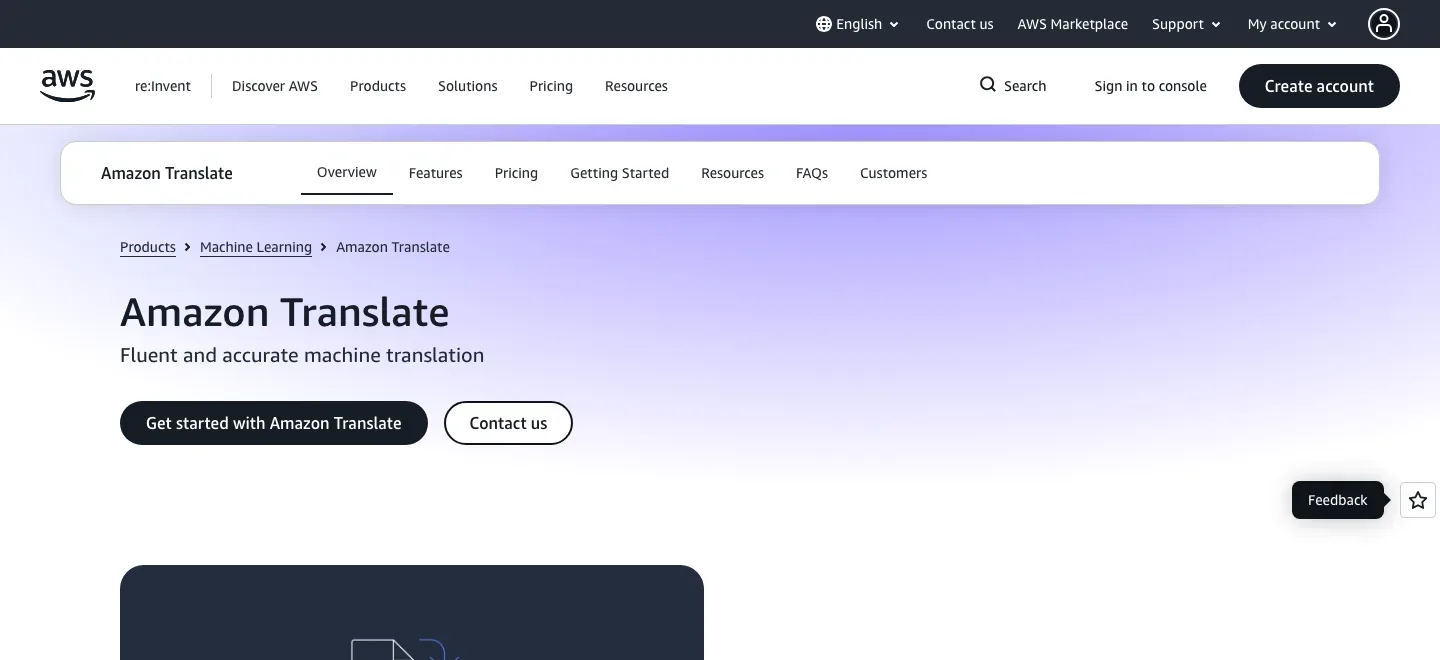
Amazon Translate is a translation engine. It lives inside Amazon Web Services (the cloud infrastructure that runs roughly a third of the internet), and it was built for developers who need to translate millions of words programmatically. It doesn’t have a slick landing page with a text box. It has an API, an SDK, and a pricing model measured in millions of characters.
So why is it on a site for authors?
Because buried inside this enterprise tool is a feature that no consumer translation app offers. You can teach the system how you translate. Feed it a professionally translated chapter of your novel, and it learns your translator’s style and word choices. Then it applies those patterns to the rest of your manuscript. For authors working in series or translating multiple books, that changes the economics of reaching international readers in ways that DeepL and Google Translate simply can’t match.
The Origin Story (It’s Not Romantic)
Amazon Translate launched at AWS re:Invent in November 2017. Google Translate had already been around for over a decade, and DeepL launched the same year.
There’s no scrappy founder story here. Amazon built this because they needed it. The company operates in dozens of countries, sells products in multiple languages, processes customer communications across all of them. They needed translation infrastructure that could scale to billions of characters without flinching, so they built it and then opened it up to everyone else.
That tells you everything about the tool’s personality. Amazon Translate doesn’t try to charm you. It tries to be reliable and cheap at massive scale. Those aren’t qualities that make for exciting marketing copy, but they’re exactly the qualities that matter when you’re translating a 90,000-word novel and watching the bill.
What It Actually Does
Amazon Translate is a neural machine translation service supporting 75 languages and 5,550 language pair combinations. It handles both real-time translation (paste text in, get translation back) and batch processing (upload a folder of documents, come back later for the results).
There are three ways to access it.
The AWS Console. A web interface inside your AWS account where you can paste text (up to about 10,000 characters at a time) and get an instant translation. It’s the closest thing to a traditional translation app experience, and it’s useful for testing and small tasks.
The API and SDKs. For anything at scale, you call Amazon Translate through code. AWS provides SDKs for Python, JavaScript, .NET, Java, and others. This is how most people use the service in production.
Batch translation. Upload documents to Amazon S3 (Amazon’s cloud storage), point Amazon Translate at them, and let it process everything asynchronously. It handles Word documents, PowerPoint files, Excel spreadsheets, HTML, and plain text. It does not handle PDFs directly, which is annoying.
The service also includes some refinement features that matter for authors.
Formality controls. You can set translations to use formal or informal register. This seems like a small thing until you’re working in a language where the distinction between “tu” and “vous” (or “du” and “Sie”) changes the entire tone of a passage.
Profanity masking. If you need a clean translation (for, say, a YA novel being adapted for a school market), Amazon Translate can automatically mask profane words. Not my vibe, but it exists :)
Brevity mode. Some translations naturally expand the text (English to German is notorious for this). Brevity mode produces more concise output, which is useful for back cover copy or ad text where you’re fighting for space.
Auto-detect. The system identifies the source language automatically. Handy if you’re processing reader correspondence that arrives in multiple languages.
The Feature That Changes the Math
Every translation tool offers glossaries. You can tell DeepL that “Shadowmere” should stay as “Shadowmere” in German. Amazon Translate does this too, through Custom Terminology. Upload a CSV or TMX file with your terms, and the system preserves them. Up to 10 MB per file, no additional cost.
But the feature that genuinely sets Amazon Translate apart is Active Custom Translation.
Active Custom Translation lets you upload “parallel data,” pairs of source text and their professional human translations. When you run a batch translation job with this parallel data attached, Amazon Translate doesn’t just use its general model. It adapts its output to match the tone and vocabulary of your reference translations.
Say you’ve had Book 1 of your fantasy series professionally translated into Spanish. You upload those source-and-translation pairs as parallel data. When you then run Book 2 through Amazon Translate, the output reflects your translator’s choices. The same character name renderings. The same approach to dialect and formality in dialogue.
This isn’t a custom model that takes weeks to train. It happens at runtime, during the translation job itself. You’re telling the system, “Translate this new text, but make it sound like that translator did it.” The output still needs professional review (machine translation always does), but you’re starting from a much closer place than a generic translation would give you.
For series authors, this is significant.
Professional literary translation is expensive, often running $0.10 to $0.20 per word. A 90,000-word novel can cost $9,000 to $18,000 to translate. If Active Custom Translation reduces the editing time your translator spends on subsequent books by even 30 to 40 percent, the savings add up fast across a multi-book series.
Active Custom Translation runs at $60 per million characters (about four times the standard rate), which works out to roughly $27 for a 90,000-word novel. Even at the premium rate, the raw translation cost is a rounding error compared to the professional editing that follows.
The Honest Tradeoffs
It’s not a consumer product. Amazon Translate lives inside AWS. To use it, you need an AWS account. To do anything beyond pasting text into the console, you need some comfort with cloud services, S3 buckets, and (for advanced features) API calls or command-line tools. If “S3 bucket” sounds like something you’d find at a hardware store, this tool will frustrate you.
Translation quality sits behind DeepL. In comparative tests, Amazon Translate consistently ranks below DeepL for translation naturalness, particularly with European language pairs. It’s functional and accurate, but the output reads more like competent business prose than literary text. For creative work, you’ll need more post-editing than you would with DeepL.
No PDF support. You can translate Word documents, PowerPoints, spreadsheets, HTML, and plain text. But if your manuscript is in PDF format, you’ll need to convert it first or use Amazon Textract (a separate AWS service) to extract the text. It’s an extra step that gets old fast.
Your data may be used. Unlike DeepL, which states it doesn’t use subscriber text to train models, Amazon’s data protection policy notes that content processed through Amazon Translate may be used to improve the service. You can opt out through an AWS Organizations policy, but it’s not the default. For authors translating unpublished manuscripts… yeah, check that setting.
The console is limited. The web interface caps you at roughly 10,000 characters per translation (about 1,500 to 2,000 words). For anything longer, you’re using the API or batch processing. This isn’t a tool where you paste in a chapter and hit “translate.”
The free tier expires. New AWS accounts get 2 million characters per month free for the first 12 months (roughly 330,000 words). After that, you pay for every character. The pricing is straightforward ($15 per million characters for standard translation), but if you’re used to DeepL’s unlimited paid plans, the per-character model takes some getting used to.
Who This Is Actually For
Amazon Translate makes sense for a specific kind of author. Someone comfortable with technology who’s translating at volume and wants granular control over the process.
If you’re a self-published romance author with a 20-book series and you’ve had the first few books professionally translated into German, Active Custom Translation could meaningfully reduce costs on the rest of the series. If you’re a nonfiction author who publishes in multiple languages and wants consistent terminology across editions, Custom Terminology handles that cleanly.
If you just want to quickly translate your book description into French for a foreign listing? DeepL. It’s simpler, faster, and will give you better-sounding output. No contest.
The sweet spot is somewhere between “I need a quick translation” and “I need to hire a full translation agency.” It’s for authors who are willing to invest time in setup because the payoff comes at scale.
Pricing at a Glance
Amazon Translate uses pure pay-per-use pricing with no subscriptions or commitments.
The Free Tier gives new AWS accounts 2 million characters per month for 12 months. Standard translation costs $15 per million characters (roughly $6.75 for a 90,000-word novel). Document translation for Office formats runs $30 per million characters. Active Custom Translation with parallel data costs $60 per million characters.
To put that in perspective, translating a full-length novel through the standard API costs less than a fancy coffee. Even with Active Custom Translation, you’re looking at under $30 for a complete manuscript. The cost of translation itself is negligible. The real expense is always the professional editing that comes after.
Custom Terminology (glossaries) costs nothing additional. Parallel data storage is free up to 200 GB, then $0.023 per GB per month.
So Should You Bother?
For most authors, DeepL is the better starting point. Easier, more natural output, and no AWS account required.
But if you’re translating at scale, particularly series authors who’ve already invested in professional translation for earlier books, Amazon Translate’s Active Custom Translation offers something no consumer tool can. A way to make each subsequent translation faster and more consistent than the last. For someone staring down a 15-book series that needs to reach Spanish and German readers, that feature alone might justify learning what an S3 bucket is.