
You’ve finished your novel. Or at least you’ve finished a draft that looks like a novel if you squint. The word count is right. The characters make it from chapter one to the end without dying accidentally (unless they were supposed to). There’s a plot, probably.
Now what?
The honest answer, for most authors, is uncertainty. You know the manuscript needs feedback, but professional developmental editing costs thousands of dollars and takes weeks. Beta readers are wonderful but unreliable. Your spouse read it and said “it’s great, honey,” which is kind and useless. You want someone to tell you whether the pacing holds up, whether your characters feel distinct from each other. You want confirmation that chapters eight through twelve don’t drag as much as you secretly suspect they do.
Marlowe was built for exactly that moment.
A Bestselling Author and a Data Scientist Walk Into a Startup
The story behind Marlowe starts in 2016, back when AI writing tools weren’t a thing anyone discussed at conferences (or anywhere else, really).
Dr. Matthew Jockers, a data scientist, had spent years studying what makes novels succeed commercially. Not in the abstract, motivational-poster sense. In the data. He and co-author Jodie Archer published The Bestseller Code, a book demonstrating that machine learning could predict whether a novel would hit bestseller lists with 83% accuracy. The patterns were real and measurable. Pacing rhythms, dialogue ratios, thematic density, character arc structures. Bestselling fiction, it turns out, shares identifiable DNA.
The technology worked. But it lived in academia, doing absolutely nothing for working authors. Classic.
Enter Alessandra Torre, a New York Times and USA Today bestselling romance and suspense author with over a million copies sold across 27 novels (she also writes suspense under the pen name A.R. Torre). Torre knew firsthand how painful the gap between “finished draft” and “ready manuscript” could be. Developmental editing is the most valuable feedback a novelist can get, and also the most expensive. For indie authors especially, the math rarely works.
The third co-founder, J.D. Lasica, brought the tech startup perspective. A veteran journalist turned entrepreneur, Lasica had co-founded some of the earliest grassroots web platforms and spoken about technology at venues from SXSW to the United Nations. He’s also a thriller novelist, so he understood the author side of the equation too.
Together, the three of them launched Authors A.I. in 2020 with an unusual founding coalition of over 110 bestselling indie authors who wanted, as they put it, “greater autonomy over our careers.” Marlowe went live in January 2020, more than two years before ChatGPT existed. While most of the publishing world wasn’t thinking about AI yet, these authors were already building with it.
What Marlowe Actually Does
Marlowe is not a writing tool. It doesn’t generate text or suggest sentences. It doesn’t rewrite your prose. It reads your manuscript and tells you what the data says about it.
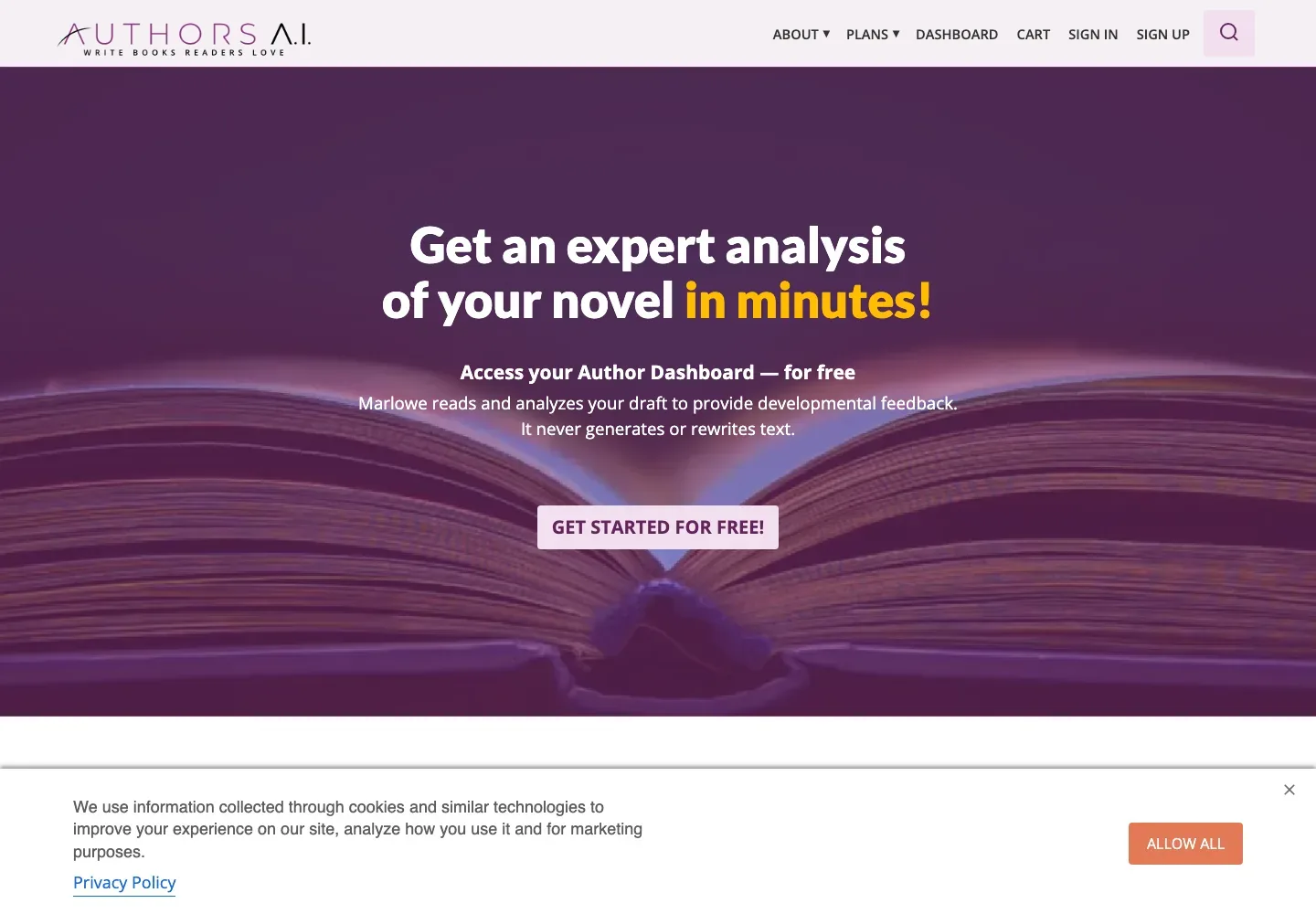
You upload your manuscript (Word or EPUB), provide some basic details like character names and point of view, and Marlowe produces a comprehensive analytical report, usually in under fifteen minutes. The Pro report runs 16 to 34 pages and covers territory that would take a human developmental editor days to assess.
The analysis includes plot structure mapped against recognized story archetypes (Hero’s Journey, Save the Cat, Three-Act Structure, and others), pacing visualization that shows where your story builds tension and where it sags, character analysis that flags when two characters read too similarly, dialogue measurement (bestsellers typically land between 25% and 35% dialogue), word usage patterns, cliché detection, and readability scoring.
All of this gets delivered to an interactive Author Dashboard where you can dig into the details and compare sections. You can also track how your manuscript changes between revisions, which is genuinely useful if you’re the type to do four rounds of edits before breakfast (hi, that’s me).
The Feature That Nothing Else Replicates
Lots of tools can check your grammar. A few can flag overused words or measure readability. But Marlowe does something I haven’t seen anywhere else in the author tool ecosystem. Genre-specific bestseller benchmarking.
Marlowe doesn’t just analyze your manuscript in isolation. It compares your work against a database of novels that actually hit bestseller lists (New York Times entries with ten or more weeks on the charts), filtered by your specific genre across 22 fiction categories. It will tell you which published bestseller your manuscript most closely resembles, broken down by word choice, pacing, themes, and structural patterns.
Dr. Jockers says the current system achieves 93-95% accuracy predicting commercial viability. Whether that number makes you excited or skeptical probably says something about your relationship with data. Either way, it’s a type of feedback that simply doesn’t exist anywhere else. And that’s kind of wild when you think about it.
This isn’t “your book is like The Hunger Games because they’re both sci-fi.” The comparison is granular. Marlowe can tell you the matching percentage across specific metrics and explain why it drew the comparison. That level of transparency sets it apart from tools that give you a score without showing the math.
Reading Without Writing
Every other AI tool on this site wants to help you write. Marlowe doesn’t. It occupies a category of one, purely diagnostic, reading your manuscript and telling you what the data says without ever generating a single word of fiction. That distinction matters more than you’d think, for both practical and ethical reasons.
On the practical side, Marlowe uses classical machine learning and natural language processing, not large language models like GPT or Claude. That means it doesn’t hallucinate. When Marlowe says your pacing drops in chapter nine, that’s based on measurable patterns in the text, not a probabilistic guess. The analysis is data, not opinion.
On the ethical side, Marlowe never trains on submitted manuscripts. All training data was legally purchased or obtained with publisher permission. Your manuscript goes in, a report comes out, and your words stay yours. The Authors A.I. team has publicly committed to never building generative AI features. If you’re worried about disclosure requirements on platforms like Amazon KDP, using Marlowe doesn’t trigger any content-generation flags because nothing is being generated.
That ethical stance isn’t incidental. It’s baked into the founding. When your company was created by 110 working novelists, “don’t train on our books without permission” is less a policy decision and more a survival instinct.
Who This Is For (and Who It Isn’t)
Marlowe makes the most sense for fiction writers who are past the first draft stage and want structural, developmental feedback before investing in a human editor. Think of it as triage. Marlowe can tell you where the problems are so that when you do hire an editor (and you probably should), you’ve already addressed the biggest structural issues. Your editor can focus on the nuanced work that requires a human brain, and you’ve saved both of you time.
It’s particularly valuable for indie authors who publish frequently and can’t afford a full developmental edit on every book. At $19.95 per month for four reports, the economics are compelling compared to even a single developmental editing session.
If you write series fiction or romance on a rapid release schedule, the benchmarking features are where this tool really earns its keep. Marlowe was trained on genre fiction that sells, and it evaluates your work through that lens.
Now, the honest limitations. Because no tool is perfect, and I’d be doing you a disservice if I pretended otherwise.
Marlowe diagnoses but doesn’t treat. It will tell you your pacing drops in chapters eight through twelve. It will not tell you how to fix it. You need your own craft knowledge or a human editor for that. This is the single most important thing to understand about Marlowe. It’s a diagnostic tool, not a repair manual.
Context awareness has gaps. The cliché detector doesn’t distinguish between narration and dialogue. If your character deliberately speaks in clichés (because that’s who they are), Marlowe will flag it the same as lazy writing. It’s counting patterns, not reading for intent.
The bestseller comp feature is imperfect. Some users have found their manuscripts compared to books that feel nothing like what they wrote. The comparison is data-driven across multiple metrics, which means the “match” might be structural rather than tonal. Take comps as one data point among many.
Fiction only, essentially. Non-fiction is technically supported, but the tool was built around fiction patterns. Non-fiction writers should look elsewhere.
No integration with your writing process. Marlowe is a batch process. Upload, wait, read the report. There’s no plugin for Scrivener or browser extension. No real-time feedback while you write. You come to it when you’re ready for analysis, not while you’re drafting.
Minimum 10,000 words. Short story and flash fiction writers are out of luck. Sorry, friends.
Is It Worth It?
Professional developmental editing is still the gold standard, but it’s expensive and slow. Marlowe won’t replace a human editor, and the team behind it doesn’t claim it will. What it offers is a fast, data-driven first pass that costs less than a decent dinner out.
Upload your manuscript on a Tuesday evening, and before you go to bed you’ll know whether your pacing holds and whether your characters feel distinct. You’ll see how your story compares to books that found large audiences in your genre. That kind of feedback used to require weeks and a four-figure check.
The Basic report is free. The Pro report goes deeper. Neither will write your book for you, and that’s rather the point.
Frequently Asked Questions
Does Marlowe support Portuguese, Spanish, or other non-English languages?
Marlowe currently supports English-language manuscripts only. Its machine learning models were trained on English-language bestsellers from the New York Times lists, so its pacing analysis, dialogue benchmarks, and genre comparisons are all calibrated to English fiction. There is no public timeline for adding other languages.
What file formats does Marlowe accept?
Marlowe accepts Word documents (.docx) and EPUB files. If you use Scrivener, compile your manuscript as an EPUB rather than a .docx for best results.
Is there a minimum or maximum word count?
Manuscripts must be at least 10,000 words. There is no stated maximum, though manuscripts over 120,000 words may take longer to process.
Does Marlowe write or rewrite any of my text?
No. Marlowe is purely analytical. It reads your manuscript and produces a diagnostic report. It never generates, suggests, or rewrites any prose. Using Marlowe does not trigger AI-generated content flags on publishing platforms like Amazon KDP.
Will Marlowe train on my manuscript?
No. Authors A.I. has publicly committed to never training on submitted manuscripts. Your manuscript is analyzed and the report is generated, but your text is not added to any training dataset.
How long does it take to get a report?
Most reports are delivered within 15 minutes of uploading your manuscript. Longer manuscripts may take slightly more time.