
You finished the book. Congratulations. That alone puts you ahead of roughly 97% of people who say they’re going to write one someday. Pop the champagne, call your mom, take a victory lap around the kitchen.
Now write your blurb.
If that sentence made your stomach clench, you’re not alone. Ask any indie author what the hardest part of publishing is, and a surprising number won’t say “writing the book.” They’ll say “everything that comes after.” The blurb. The keywords. The comparable titles. The ad copy. The social media posts. The category selections. The press release nobody reads but everybody apparently needs. Marketing a book requires you to become a completely different kind of writer, one who can distill 80,000 words of layered storytelling into a punchy three-paragraph sales pitch that convinces strangers to spend $4.99.
Most of us didn’t sign up for that. We signed up to write books.
ManuscriptReport was built on a deceptively simple idea. Your manuscript already contains everything you need to market it. The themes are in there. The hooks are in there. The comparable titles, the audience profile, the emotional selling points, all of it is woven into the text you spent months writing. You just need something that can read the whole thing and pull it out.
An NLP Researcher Walks Into Publishing
Florin Bulgarov didn’t come from the publishing world. He came from the other direction entirely.
With a PhD in Artificial Intelligence and over a decade of hands-on NLP experience, Bulgarov spent years in the academic corners of AI research, publishing papers at conferences like EMNLP, COLING, and AAAI on topics like keyphrase extraction and proposition analysis. Teaching machines to read documents and identify what matters most. (You know, casual stuff.)
When large language models started showing they could grasp long-form context and produce stylistically coherent prose, Bulgarov saw a fit that most AI researchers would’ve missed. Books are long documents full of structured information (characters, themes, emotional arcs, market positioning signals) that authors struggle to extract and articulate on their own. This was basically the keyphrase extraction problem scaled up to novel length.
ManuscriptReport launched in 2024, starting at $14.99 per report and positioned for publicists and marketers. But the audience that actually showed up was overwhelmingly indie authors, people doing their own marketing because nobody else was going to do it for them. Bulgarov repositioned accordingly. The pricing evolved as the reports grew more comprehensive, and today over 1,500 authors have used the service.
Twenty Minutes From Manuscript to Marketing Kit
The core service is straightforward. You upload your completed manuscript (PDF, DOCX, or EPUB), provide your title and author name, and ManuscriptReport’s AI performs what it calls “recursive chunking,” reading through the entire text, analyzing content, themes, writing style, and market positioning signals. About twenty minutes later, you get a formatted PDF report.
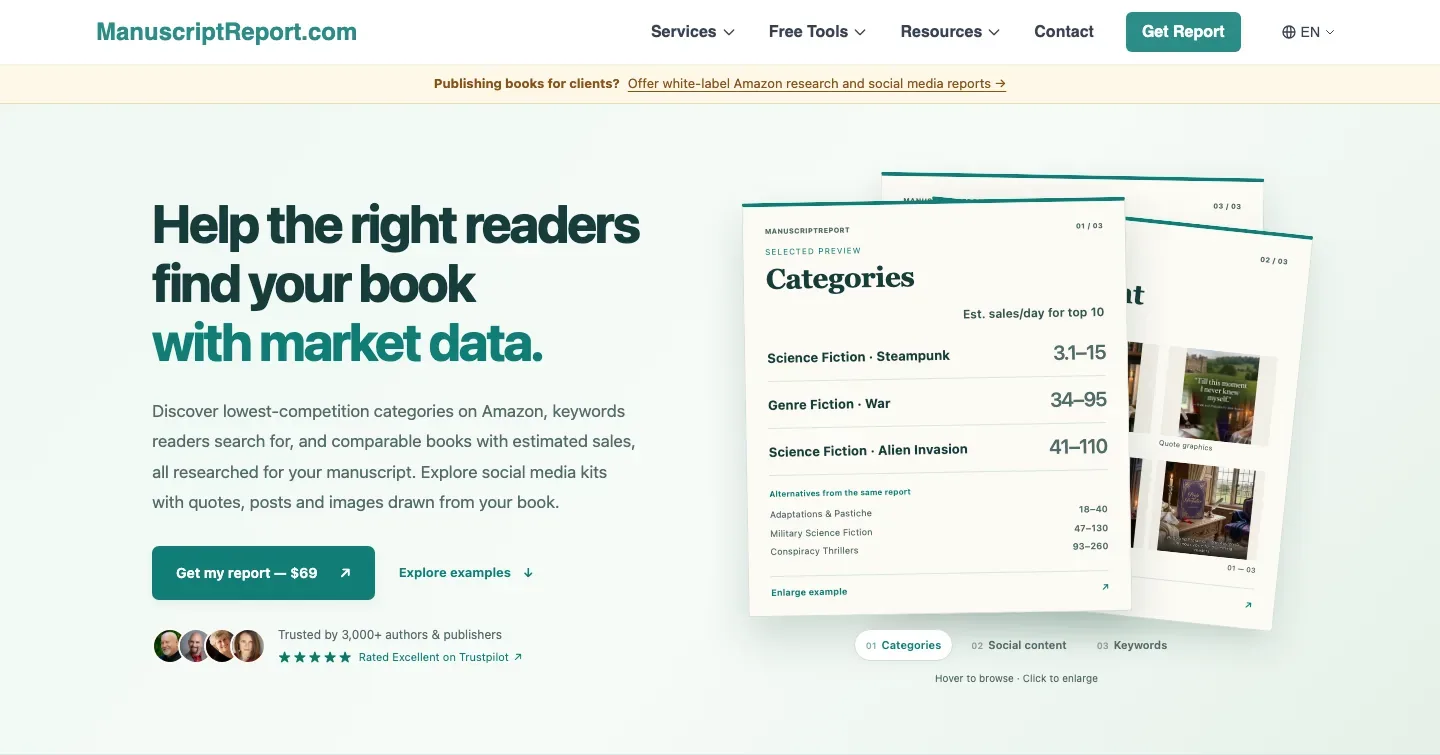
The Book Marketing Report, the flagship product at $69, runs twenty sections deep. That includes a back-cover blurb, a full synopsis with story structure, ten comparable titles with detailed analysis, KDP keywords optimized for Amazon search, target audience profiles broken down by demographics and psychographics, genre classification with percentage breakdowns, themes and tropes analysis, “X meets Y” positioning statements, multiple variations of ad copy, a press release template, a blog series outline, reader magnet ideas, and a timeline-based marketing strategy covering pre-launch through ongoing promotion.
That’s the kind of deliverable you’d get from a marketing consultant, except it costs $69 instead of $2,000 and arrives in twenty minutes instead of two weeks. I love math like that.
What Makes This Different From Just Asking ChatGPT
You could paste your manuscript into ChatGPT and ask it to write you a blurb. People do this. It sort of works.
The difference is depth and structure. When you ask a general-purpose AI to write a blurb, it’s working from whatever portion of your manuscript fits in the context window, using generic prompting, and producing a single output that may or may not capture what actually makes your book marketable. You’ll iterate, re-prompt, tweak, and spend an hour getting something serviceable.
ManuscriptReport’s approach is purpose-built for this specific problem. The recursive chunking algorithm processes your entire manuscript (not just the parts that fit in a prompt), the analysis covers twenty distinct marketing dimensions simultaneously, and the outputs are formatted for immediate use. The comp title analysis alone, ten detailed comparisons with reasoning behind each match, would take hours of manual Amazon research.
The outputs are also designed to work together. The keywords inform the category selections, the audience profile shapes the ad copy, the comp titles feed into the positioning statements, and all of that connects back to the social media angles. It’s an integrated marketing strategy derived from your specific text, not a collection of individual AI responses stitched together.
Beyond the Report
The Marketing Report is the centerpiece, but ManuscriptReport offers three additional paid services.
The Social Media Package ($69) generates twenty-plus custom images with captions and ad copy, giving you roughly a month of social media content tailored to your book. The Blog Series ($49) extracts up to ten SEO-optimized articles from your manuscript’s themes and subject matter, useful for content marketing that drives organic search traffic back to your book. The Book Bible ($39) catalogs characters, locations, timelines, and worldbuilding details into a structured reference document. That last one is more useful for fiction writers managing series than for marketing, but if you’re knee-deep in a fantasy saga with seventeen named characters… you get it.
There’s also a suite of free tools that let you test the waters without spending anything. A Blurb Generator, a Blurb Critique tool, a KDP Keyword Generator, a Comp Title Finder, and a Publishing Path Quiz that helps you figure out which publishing path makes the most sense for your situation. These are genuinely useful on their own, not just teasers designed to funnel you into a purchase.
No Subscription, No Recurring Charges
Every service is priced per report. No monthly subscription. No annual commitment. No account tier you need to maintain. You pay when you need a report, and you don’t pay when you don’t. (What a concept.)
For a lot of indie authors, this pricing model is a relief. If you publish one book a year, you spend $69 once and you’re done. If you publish four books a year, that’s $276 total for marketing kits that would cost orders of magnitude more from a human consultant. The math is straightforward and you’re never paying for months you don’t use.
The tradeoff is that prolific authors who also want the Social Media and Blog Series packages for every release will see costs add up. But even bundled together, the full suite for a single book runs under $230, which is still a fraction of professional marketing services.
Your Manuscript Stays Yours
ManuscriptReport’s data policy directly addresses a fear that a lot of authors carry about AI tools. Your manuscript is never used to train AI models. All uploaded data is deleted from their systems within 30 days. You maintain full ownership and control over everything. They’ve also partnered with the Alliance of Independent Authors (ALLi) and Draft2Digital, organizations that take author rights seriously and wouldn’t lend their names to a platform that played fast and loose with manuscripts.
For authors who are cautious about uploading unpublished work to AI-powered services (and that caution is reasonable), these commitments matter.
Who This Is For
ManuscriptReport is built for a specific moment in the publishing process. The gap between “I finished my book” and “now I need to sell it.” If you’re an indie author handling your own marketing, if you’ve ever stared at the KDP keyword fields and just… guessed, if your book description was written at midnight under deadline pressure and you’ve always suspected it undersells your story, this is the tool that fixes that.
It’s also valuable for authors working with small presses or hybrid publishers who provide limited marketing support. And for anyone publishing on Amazon specifically, the KDP keyword and category optimization could pay for the report many times over if it helps your book surface in the right searches.
Who This Isn’t For
If your manuscript isn’t finished, ManuscriptReport can’t help you yet. This is a post-writing tool. It doesn’t provide developmental feedback or suggest revisions. It reads a completed book and produces marketing materials. If you’re still drafting or revising, check out the writing and editing tools on this site instead.
If you’re a traditionally published author with a full marketing team at your publisher, you likely already have people doing this work. (Though a $69 sanity check against your publisher’s positioning might be interesting.)
And if you expect AI-generated marketing copy to be publish-ready without any human editing, calibrate your expectations. The outputs are strong starting points that will save you significant time, but you’ll still want to read everything, adjust the voice to match your brand, and make sure the blurb actually sounds like something you’d write. Think of it as a very competent first draft of your marketing, not the final version.
The Gap Nobody Else Fills
The AI writing space is packed with tools that help you write the book. Tools that help you market it afterward, using the book itself as source material? Those barely exist.
ManuscriptReport is one of the few that recognized the after part is where most indie authors actually get stuck. For $69 and twenty minutes, you never have to stare at a blank KDP keyword field at 2 AM wondering what the hell to type.