
ScribeShadow: The Translation Tool Built by Indie Publishers Who Couldn't Afford Translators

By Morgan Paige Published February 27, 2026
ScribeShadow logo

You know that moment when you run the numbers on something and your soul quietly leaves your body?

A professional literary translator charges between five and fifteen cents per word. Your 80,000-word novel runs $4,000 to $12,000, per language. Multiply that by twelve and you’re looking at a down payment on a house. For a small indie press running lean, the math doesn’t just fail. It mocks you.

This wasn’t a hypothetical for Marisa and her husband. This was a Tuesday.

A Small Press With a Big Problem

Marisa and her husband ran a small publishing press. The books sold. The audience was there. And every time they looked at international markets, they hit the same wall.

Traditional translation is priced for traditional publishers with dedicated foreign rights departments and six-figure marketing budgets. For the rest of us, it’s a nice daydream.

When AI translation tools started getting good in 2023 and 2024, Marisa’s husband saw a way through. Not another generic translation API in a pretty wrapper, but something designed specifically for the workflow of translating a full-length book. The kind of tool they wished had existed when they were trying to grow their press.

That tool became ScribeShadow.

How It Works (Without the Marketing Gloss)

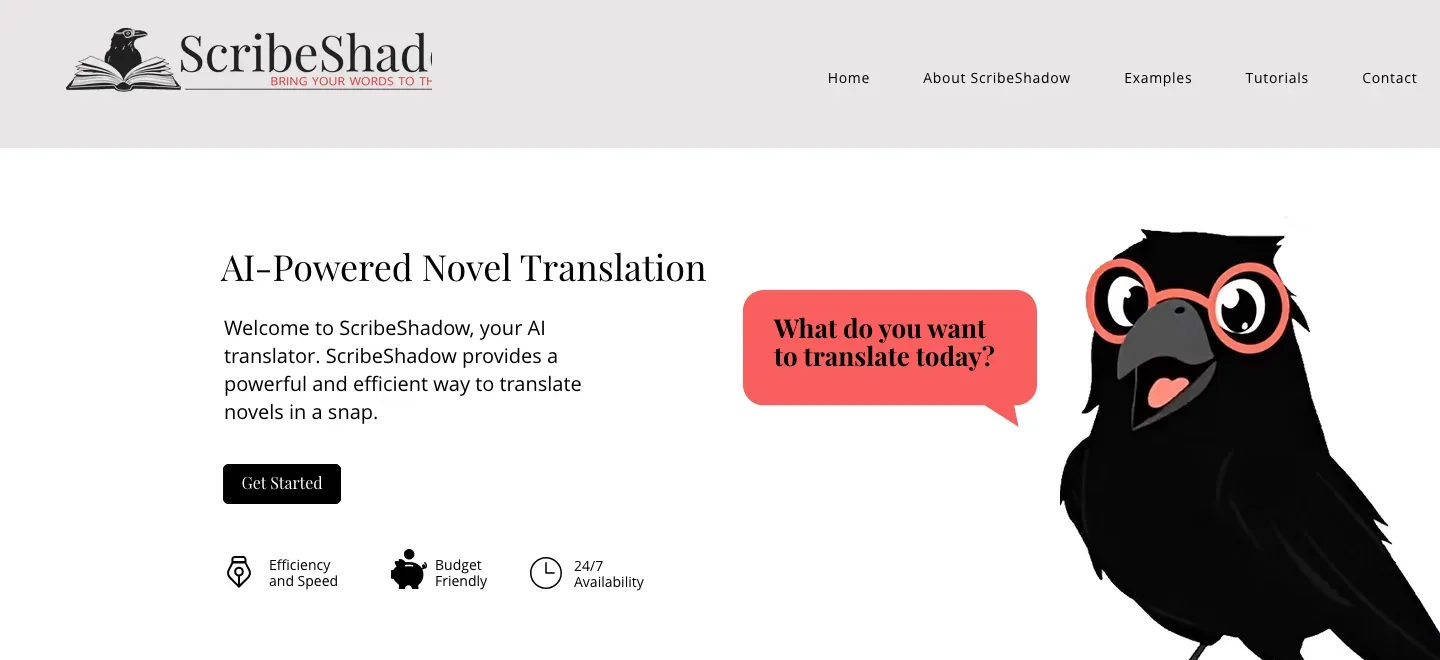
The workflow is refreshingly simple. You create an account at app.scribeshadow.com, upload your manuscript as a .docx or .epub file, enter some metadata about your book (genre, tone, that sort of thing), pick your target language, and choose an AI model. Within minutes, you get a translated file back in .epub format, organized by chapter.

That metadata step matters more than you’d think. By telling ScribeShadow that your book is, say, a cozy mystery with a lighthearted tone, you’re giving the AI context that shapes word choices and phrasing. A cozy mystery and a military thriller may use the same vocabulary in English, but the way those words land in French is very different. The metadata nudges the translation toward the right register.

ScribeShadow currently supports over 19 languages, including Spanish (both European and Latin American), German, French, Italian, Brazilian Portuguese, European Portuguese, Dutch, Hindi, Thai, Swedish, Polish, Ukrainian, Russian, and simplified Chinese. Some languages are still in beta, meaning the team is actively refining translation quality. German and French are the most popular among users, with Italian close behind, and those tend to produce the most polished results.

The platform doesn’t store your manuscripts or use your content to train AI models. If you’re translating unpublished work, you’ll care about that.

The Matchmaker

Every translation app uses AI. ScribeShadow does something that, as far as I can tell, nobody else is doing. It matches each language with its strongest AI model.

This sounds like a small technical detail. It isn’t.

Different AI models have different strengths across languages. Claude might produce excellent French but merely good Brazilian Portuguese. DeepSeek might handle Chinese beautifully but stumble on Dutch idioms. Most translation tools pick one model and use it for everything. ScribeShadow’s team continuously tests multiple AI engines against each supported language and marks the best-performing model as “recommended” for that language pair.

When you select a target language, the platform tells you which model its testing has found to be the strongest match. You can override this and pick a different model if you prefer, but the recommendation removes the guesswork. You don’t need to know anything about AI model architectures or comparative benchmarks (thank god). You just need to trust that someone has done the testing for you.

Marisa has mentioned in interviews that sometimes the best model for a given language is an older one. The newest, most hyped model isn’t always the winner. You only figure that out by actually doing the work, not by reading press releases.

For authors, the practical impact is consistency. Your German translation and your Spanish translation are each produced by whichever model does the best job for that language, rather than by whichever model the company happened to partner with.

What Else Is Under the Hood

Beyond core translation, ScribeShadow handles several adjacent tasks that matter when you’re going international.

Metadata translation. Your book description and keywords need to be in the target language too, along with your subtitle. ScribeShadow translates these alongside your manuscript, so you’re not cobbling together your German blurb in a separate tool.

Cover text translation. If your cover has text that needs translating (a subtitle or a series marker like “Book One of the…”), the platform handles that.

AI-based proofreading. The platform offers translation refinement tools, letting you review and adjust passages after the initial translation. ScribeShadow has also partnered with WordCount.ink, a proofreading service, for authors who want a human set of eyes on their translated text.

Community resources. ScribeShadow maintains groups on Facebook and Discord where users share strategies, discuss which languages are performing well in specific genres, and compare notes on translation quality. The team is also building a global marketing trends database to help authors identify which genres sell well in which markets.

That last one hints at something bigger. ScribeShadow seems to be building the infrastructure for a question most authors don’t even know to ask, whether translating into a specific language is worth the investment in the first place.

What It Actually Costs

Most authors make this decision based on cost.

ScribeShadow runs on a credit-based subscription system. There’s a free tier with 2,175 credits (enough to translate a chapter or two and kick the tires). Beyond that, the main plans are the Storyteller at $49 per month (roughly enough for a 50,000-word book) and the Novelist at $129 per month (roughly 150,000 words of translation). Higher-volume plans exist for authors working on box sets or translating into many languages simultaneously.

Compared to a human translator at $0.05 to $0.15 per word, the savings are dramatic. Translating an 80,000-word novel with a human translator might cost $8,000. Through ScribeShadow, you’re looking at $100 to $200 depending on your plan and the language.

But “cheaper than a human translator” isn’t the only comparison worth making. You could use Claude or ChatGPT and translate chapters manually through the API. That approach costs less, sometimes significantly less. What you give up is the workflow. With a generic API, you’re managing file uploads, splitting chapters, handling formatting, and doing your own quality testing across languages. ScribeShadow packages all of that into a single interface purpose-built for books.

The convenience premium is real. Whether it’s worth it depends on how many books you’re translating and what your time is worth.

Who This Is For (and Who Should Look Elsewhere)

ScribeShadow makes the most sense for indie authors and small presses who are serious about international markets. Not “curious about maybe trying one language someday,” but authors who want to translate multiple books into multiple languages as part of their publishing strategy.

The tool shines brightest if you write genre fiction (romance, thriller, fantasy, mystery) where international markets are well-established and genre conventions translate relatively cleanly. Several authors report that their translated editions get better reviews than their English originals. Wild, right?

It’s less ideal in a few situations, though.

Highly literary or poetic work. AI translation has gotten remarkably good at functional, natural-sounding prose. It hasn’t gotten good at preserving the kind of sentence-level artistry that defines literary fiction. If every word choice in your novel is deliberate and loaded with subtext, you still need a human translator.

Languages still in beta. If your target market is a language ScribeShadow is still refining, you’ll want to have a native speaker review the output more carefully. The team is transparent about which languages are mature and which are still being optimized.

One-off, short projects. If you only need to translate a single short story or a book description, the monthly subscription may be more than you need. The free tier might cover it, but check the credit math first.

Authors who want zero AI involvement. Some readers and markets have strong opinions about AI-generated content, including AI translation. If your readership is in that camp, this tool (and every other AI translation tool) may create more friction than it’s worth.

For everyone else, especially the indie authors who’ve been watching international readers buy someone else’s books because theirs weren’t available in the right language? ScribeShadow is one of those tools that makes you wonder why it took so long to exist.

Similar Tools