
You finish your book, start daydreaming about international readers, and paste a paragraph into Google Translate. What comes back reads like it was assembled by a committee of dictionaries. The words are technically correct. The meaning is roughly intact. But the voice? Gone.
That gap between “technically correct” and “actually sounds human” is the entire reason DeepL exists.
A Dictionary That Became Something Bigger
DeepL’s origin story starts with a dictionary, not a translator.
In 2009, a former Google researcher named Gereon Frahling founded Linguee in Cologne, Germany. Linguee wasn’t traditional. Instead of matching words to definitions, it crawled the web for professionally translated documents and showed how phrases were actually used in real translated text. Need to know how a native German speaker would express “it dawned on me”? Linguee found examples from professional human translations and showed you the context.
Over several years, Linguee quietly built one of the largest collections of high-quality bilingual text on the internet. Millions of sentence pairs, all from professional translators.
In 2012, computer scientist Jaroslaw Kutylowski joined as CTO. Kutylowski (who goes by Jarek) grew up switching between Polish and German, started coding at ten, and holds a PhD in computer science with a math focus. He began experimenting with neural networks to improve Linguee’s translation verification, and the team noticed something unexpected. The neural networks, trained on Linguee’s decade of curated bilingual data, could do full machine translation. And they were significantly better than existing tools.
They’d spent years building what turned out to be a uniquely powerful training dataset for a translator, without originally intending to build one. (Sometimes the best tools are happy accidents.)
In August 2017, they launched DeepL Translator. Kutylowski became CEO in 2019, and the company has since grown to over 1,500 employees serving more than 100,000 businesses, with a valuation near $2 billion.
When asked about competing with tech giants, Kutylowski doesn’t flinch. “Unlike the US tech giants, we focused on our one goal from the very beginning. For Google, for example, the translator is just a small sub-project, whereas at DeepL we are all pulling in the same direction at full steam.”
What DeepL Actually Does for Authors
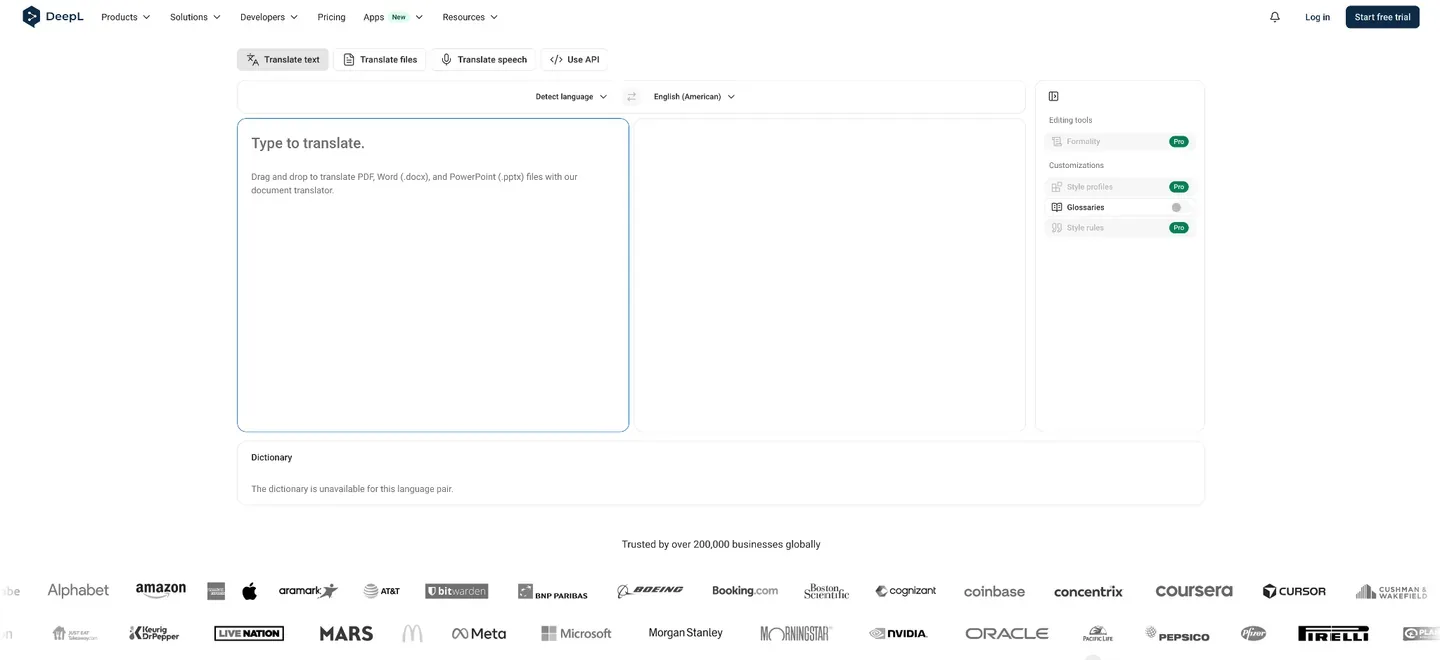
DeepL translates text between more than 100 languages. Paste in your words (or upload a document), choose a target language, get a translation back. Nothing you haven’t seen before.
The difference is what comes out the other side.
DeepL’s translations read like a person wrote them. Not a particularly creative person, but a competent bilingual one who understands context and natural idiom. Where Google Translate renders a colloquial English phrase into awkwardly literal German, DeepL tends to find the natural equivalent.
For practical author workflows, a few features stand out.
Text translation. Paste up to 50,000 characters per month on the free plan (roughly 8,000 to 10,000 words) and translate between any supported language. Paid plans bump that to a million characters on Starter and unlimited on Ultimate.
Document translation. Upload Word docs, PDFs, PowerPoints, or text files and get translated versions back with formatting preserved. Matters a lot if you’re translating a formatted manuscript or a media kit for foreign publishers. Free tier allows one file per month, paid plans scale up.
Glossaries. Create custom glossaries that tell DeepL how to handle specific terms. If your fantasy novel uses “Shadowmere” as a proper noun that shouldn’t be translated, or you want “the Guild” consistently rendered as “die Gilde” in German, glossaries enforce that. Ultimate plans offer up to 250 glossaries with unlimited entries.
DeepL Write. A writing assistant that handles grammar and tone adjustments in your target language. Currently limited to a smaller set of languages, but it’s a nice bonus for polishing translations without leaving the app.
Why the Translations Are Better
Every translation app uses AI. The question is what that AI learned from.
Most machine translation systems train on the open internet. Billions of pages, statistical patterns, output that reflects the average quality of everything out there. Fine for restaurant menus.
DeepL’s AI grew up on Linguee’s curated corpus of professional human translations. Seven years of bilingual text pairs, verified for accuracy before they ever touched the training data. Think of it as learning a language by reading published novels versus learning it from Reddit comment threads.
In blind tests, professional translators found DeepL’s output required two to three times fewer edits than translations from Google Translate or ChatGPT. For authors, that’s the gap between “I can send this to my foreign publisher with light editing” and “I need to hire someone to redo this from scratch.”
DeepL is also notably private. The company doesn’t use subscriber text to train its models. If you’re translating unpublished manuscripts, your unfinished novel isn’t becoming someone else’s training data. That’s not a footnote. That’s a feature.
Where It Falls Short
Language coverage. Google Translate still handles roughly twice as many languages. DeepL expanded from 36 to over 100 in late 2025, but if you need a less common language pair, Google may be your only realistic option. DeepL’s strength is depth over breadth, particularly with European languages.
Machine translation isn’t literary translation. DeepL produces natural-sounding prose. It does not produce art. Wordplay, cultural references, your specific narrative voice… these require a human translator who understands both cultures intimately. If you’re publishing a translated edition, DeepL is your starting point, not your finished product.
The free tier runs out fast. 50,000 characters sounds generous until you realize that’s roughly one or two chapters. (So, like, one really good argument scene between your two leads.) Authors translating full manuscripts need a paid plan, and even Starter’s million characters per month will take a few months to chew through a full-length novel.
It’s a translator, not a project management tool. If you’re coordinating with a team of translators on a big project, DeepL doesn’t offer segment history or real-time collaboration. You’d need a dedicated translation management platform for that.
Pricing at a Glance
DeepL’s free tier is genuinely useful for testing and short projects. Paid plans bill monthly, with discounts for annual commitments.
The Free plan includes 50,000 characters and one file translation per month. Starter at $10.49/month bumps that to a million characters and five file translations. Advanced runs $34.49 per user per month with a million characters and 20 file translations. Ultimate at $68.99 per user per month removes the character cap and allows 100 file translations.
Most paid plans include a 30-day free trial. Annual billing brings prices down (Starter drops to $8.74/month, for example). There’s also a Developer API with a free tier of 500,000 characters per month and a Pro tier starting at $5.49/month plus usage-based charges.
Is It Worth Your Money?
DeepL won’t replace a skilled literary translator for your published edition. What it gives you is a first draft good enough that your translator spends their time polishing instead of rewriting.
A decade ago, going international meant hiring a translator sight-unseen and hoping for the best. Now you can paste a chapter into DeepL for free, send it to a bilingual friend, and find out if your book has legs in another language before you spend a dime. For indie authors trying to figure out where to put their next thousand dollars, that kind of intel is worth way more than the free tier costs.