
Buffer AI Assistant: Write Once, Post Everywhere (Without Sounding Like a Robot)

By Morgan Paige Published February 28, 2026
Buffer logo

Buffer’s AI Assistant does something I wish more AI tools would bother with. It actually understands the platform it’s writing for.

You know how this goes. You publish a book, and every marketing blog on the internet informs you that you need to post on Instagram, X, LinkedIn, Facebook, Threads, TikTok, and maybe Bluesky. Every day. With different content for each platform, because a LinkedIn post that opens with “I’m thrilled to announce…” will get ignored on X, and a snarky tweet will fall flat on Facebook.

So you do what most indie authors do. You write one post, copy-paste it everywhere, watch it perform unevenly, and wonder why “building an author platform” feels like running six separate businesses.

Buffer was built for exactly this problem.

A Tweet-Spacing Tool That Grew Up

Buffer’s origin story is almost comically simple. In 2010, Joel Gascoigne, a developer from Sheffield, England, wanted to space out his tweets throughout the day instead of posting them all at once. So he built a tool that did that. Four days after launching, he had $5 in his PayPal account and was jumping around his apartment so enthusiastically the floorboards creaked. (Relatable energy.)

That tiny utility grew into one of the most widely used social media management platforms in the world. Gascoigne and co-founder Leo Widrich bootstrapped Buffer to $10,000 in monthly revenue before raising seed funding. When visa issues pushed them out of the US, they turned the disruption into a philosophy. Buffer became a fully remote company years before the pandemic made that fashionable, with team members scattered across dozens of countries.

Gascoigne has been explicit about building slowly and staying small on purpose. Buffer has been profitable for years and employs about 75 people. No Silicon Valley growth-at-all-costs playbook. For a tool you’re trusting with your author brand, that stability matters.

When Buffer added AI, the team spent nearly a year rebuilding the feature rather than rushing out a generic chatbot integration. The result is an AI assistant that generates text with actual awareness of where that text is going.

The Platform-Aware Trick

This is what separates Buffer’s AI from pasting your book announcement into ChatGPT and asking it to “make this work for social media.”

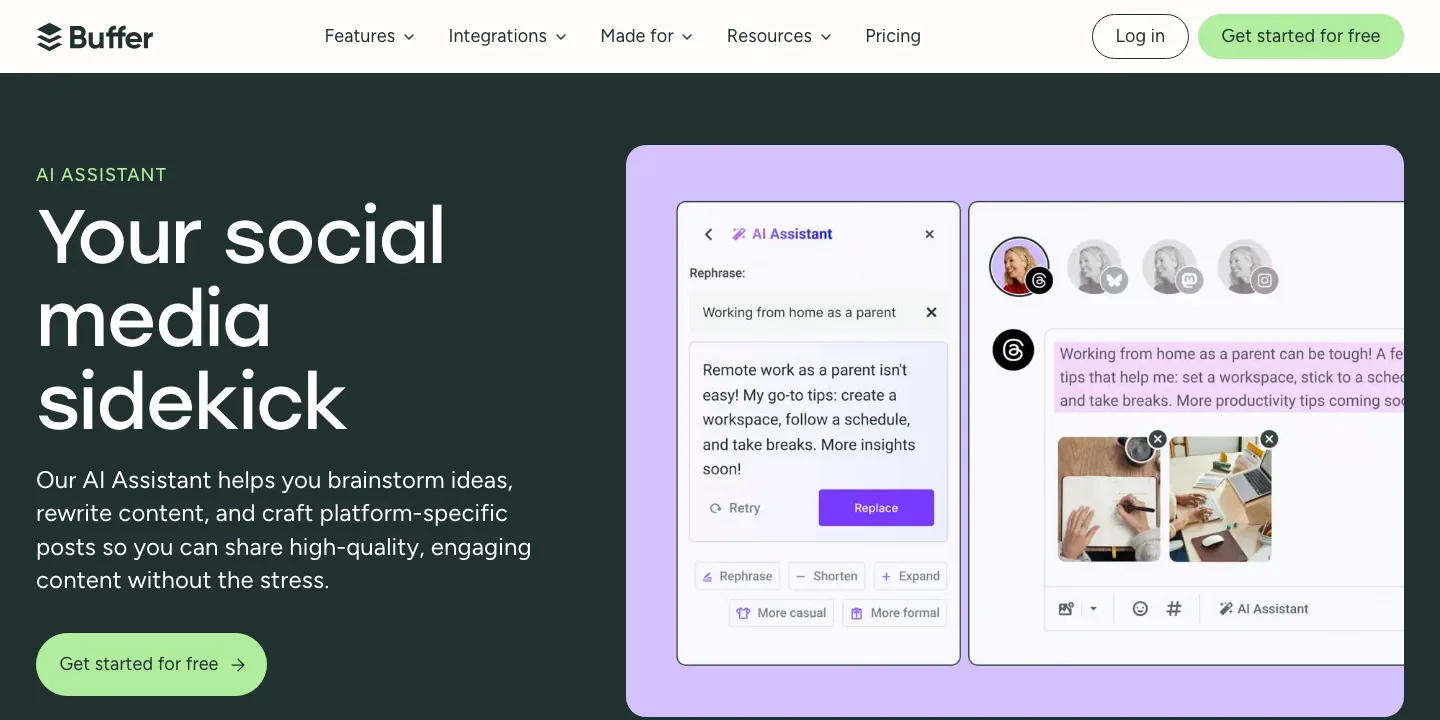
Buffer’s AI Assistant lives inside the composer, the same place where you write and schedule posts. When you open it, the AI already knows which social channel you’re creating for. That awareness shapes everything it produces.

Draft a post for LinkedIn, and the AI writes in a more professional, in-depth style. Switch to X, and it tightens everything up, respects the character limit, adjusts the tone. Instagram? The output shifts to conversational and emoji-friendly.

The AI is genuinely translating between platform dialects.

For authors, this solves a specific pain. You have one piece of news (your book launches Tuesday, you’re running a promotion) and you need it to sound native on five different platforms. Buffer’s AI lets you write one prompt, then generates channel-appropriate versions you can review and tweak before scheduling.

What You Actually Do With It

Open Buffer’s composer, click “AI Assistant,” and type a prompt. Something like “announce my cozy mystery launches next Tuesday, preorder link available, first in a series.” The AI generates a draft tailored to whichever channel you’ve selected. You can adjust the tone, rephrase it, shorten it, or expand it with single clicks.

Content repurposing is where authors get the most mileage. Paste in a link to your latest blog post or a chunk of text from your newsletter, and Buffer’s AI will create posts for each of your connected channels. A long-form LinkedIn reflection and a punchy X post, plus Instagram captions that actually sound like Instagram. All from the same source material.

Beyond the AI, Buffer includes a content workspace called Create. Think of it as a scratchpad with kanban-style organization where ideas flow from concept to draft to done. You can tag content by theme (book launch, reader engagement, behind-the-scenes) and connect RSS feeds for inspiration. It also integrates with Canva and Unsplash for images. For authors who struggle with the “what do I even post about” problem, having a structured brainstorming space beats staring at a blank compose window.

The scheduling and publishing side is what Buffer has done well for fifteen years. Queue up posts, let Buffer publish them at optimal times, check the analytics, and adjust based on what’s resonating with your audience. The full loop in one tool.

Free Is Genuinely Free

Buffer’s pricing deserves a shoutout because it bucks a trend. A lot of tools gatekeep their AI features behind premium tiers. Buffer includes the AI Assistant on every plan, including the free one.

Respect.

The free plan gives you three social channels and ten scheduled posts per channel, with the AI Assistant fully included. That’s enough for an author posting a few times a week on a couple platforms. You won’t run a full-scale book launch campaign on it, but for maintaining a steady presence between releases, it works.

If you need more, the Essentials plan runs $5 per month per channel with unlimited scheduling and AI. Connect five channels and you’re looking at $25/month, which is less than a lot of authors spend on a single Amazon ad per day. The Team plan at $10 per channel adds collaboration features if you work with a virtual assistant or marketing help.

Annual billing knocks 20% off either paid plan. There’s a 14-day free trial for testing premium features before committing.

Who This Is Actually For

Buffer’s sweet spot is the gap between “I know I should be on social media” and “I can’t spend two hours a day writing posts.” If you’re an indie author managing your own marketing, or really anyone who finds the multi-platform content treadmill exhausting, Buffer’s AI turns a tedious daily task into something you can knock out in fifteen minutes.

It’s also great for authors who already produce content (blogs, newsletters, that sort of thing) and want to squeeze more value out of it. That blog post you spent three hours writing? Buffer’s AI can break it into a week of social media posts across every platform you use. Your newsletter about the writing process? That’s Instagram captions and a LinkedIn thread waiting to happen.

Authors launching books will love the scheduling features. Map out your launch week content in advance and schedule it across all channels. Then actually focus on launch day instead of frantically posting from your phone while refreshing your sales dashboard. (Stress-refreshing your sales dashboard doesn’t count as marketing, by the way.)

Who This Isn’t For

Buffer is a social media management tool, not an author marketing platform. It won’t write your book description or analyze your manuscript for marketing angles. If you need book-specific marketing intelligence, tools like ManuscriptReport are purpose-built for that.

The AI is also a generalist. It’s good at social media copy, but it doesn’t have deep knowledge of book marketing conventions or genre-specific reader community norms. You’ll want to review and personalize everything it generates. An AI-crafted post about your romance novel that reads like a LinkedIn corporate update isn’t going to connect with your readers, no matter how polished the grammar is. The platform-awareness helps, but your author voice still needs to be the final filter.

If you only post on one platform, the core value proposition (one idea, multiple platform-native posts) doesn’t really apply. A general-purpose AI for drafting plus a simple scheduling tool would serve you better.

And like any AI content tool, Buffer’s assistant can hallucinate or produce generic output. Always read what it generates before posting. Your readers follow you, not your AI assistant ;)