
Storysnap: An AI That Reads the Book You Already Wrote

By Morgan Paige Published February 26, 2026
Storysnap logo

Every pantser I know has the same dirty secret. They finish the book (hooray!), crack open a celebratory drink… and then realize they have absolutely no idea what color their protagonist’s eyes are. Or which chapter the subplot about the missing heirloom resolves. Or whether the tavern in act two is called the Silver Stag or the Stag’s Silver.

Go ahead, check your notes.

You don’t have notes, do you? ;)

Plotters might. But a lot of authors finish a book with a manuscript and very little else. No character bible. No scene-by-scene outline. The story exists entirely inside the document and (partially, unreliably) inside the author’s memory.

Storysnap was built to fix that. Not by helping you write the book, but by reading the one you already wrote and turning it into something structured.

A Plottr Problem That Needed Its Own Product

Cameron Sutter is a software engineer, a science fiction and fantasy author, and the creator of Plottr, the visual story planning tool that’s become a favorite among plotters and series writers. He lives near Oklahoma City with his wife, six kids, and a small menagerie of pets. He’s also survived four near-death experiences (explosion, rockslide, disease, car accident), which… yeah, that probably explains the guy’s approach to everything.

The idea for Storysnap came from a pattern Cameron kept seeing in Plottr’s community. Two types of authors kept showing up with the same frustration.

The first group had big backlists. Five books, ten books, a whole series. They loved Plottr’s organizational tools, but they’d never outlined any of their published work. Building story bibles retroactively for books they’d written years ago? That’s weeks of manual labor nobody was volunteering for.

The second group were pantsers. They wrote by the seat of their pants, discovered the story as it unfolded, and had no interest in outlining before the draft. But after the draft? They could see the value. They wanted that Plottr-style organizational clarity, just applied backward, after the creative work was done.

Cameron spent about three months building a solution, starting around November 2024. What began as a “superpowered import tool” for Plottr quickly became something bigger. By early 2025, it had its own name (Storysnap, as in “in a snap, get your book organized”) and its own identity as a standalone product.

One thing I really respect about this. Cameron deliberately kept Plottr free of AI. Storysnap is a separate, opt-in product. If you’re a Plottr user who wants nothing to do with AI tools, nothing changes for you. That kind of boundary-setting is rare when most companies are cramming AI into every feature whether users want it or not.

What Happens When You Upload a Manuscript

You upload your completed manuscript (DOCX or PDF) and Storysnap goes to work. The process takes roughly five minutes, during which the tool runs your book through hundreds of specialized prompts, processing approximately ten million tokens per manuscript.

What comes back is a structured breakdown of your entire book.

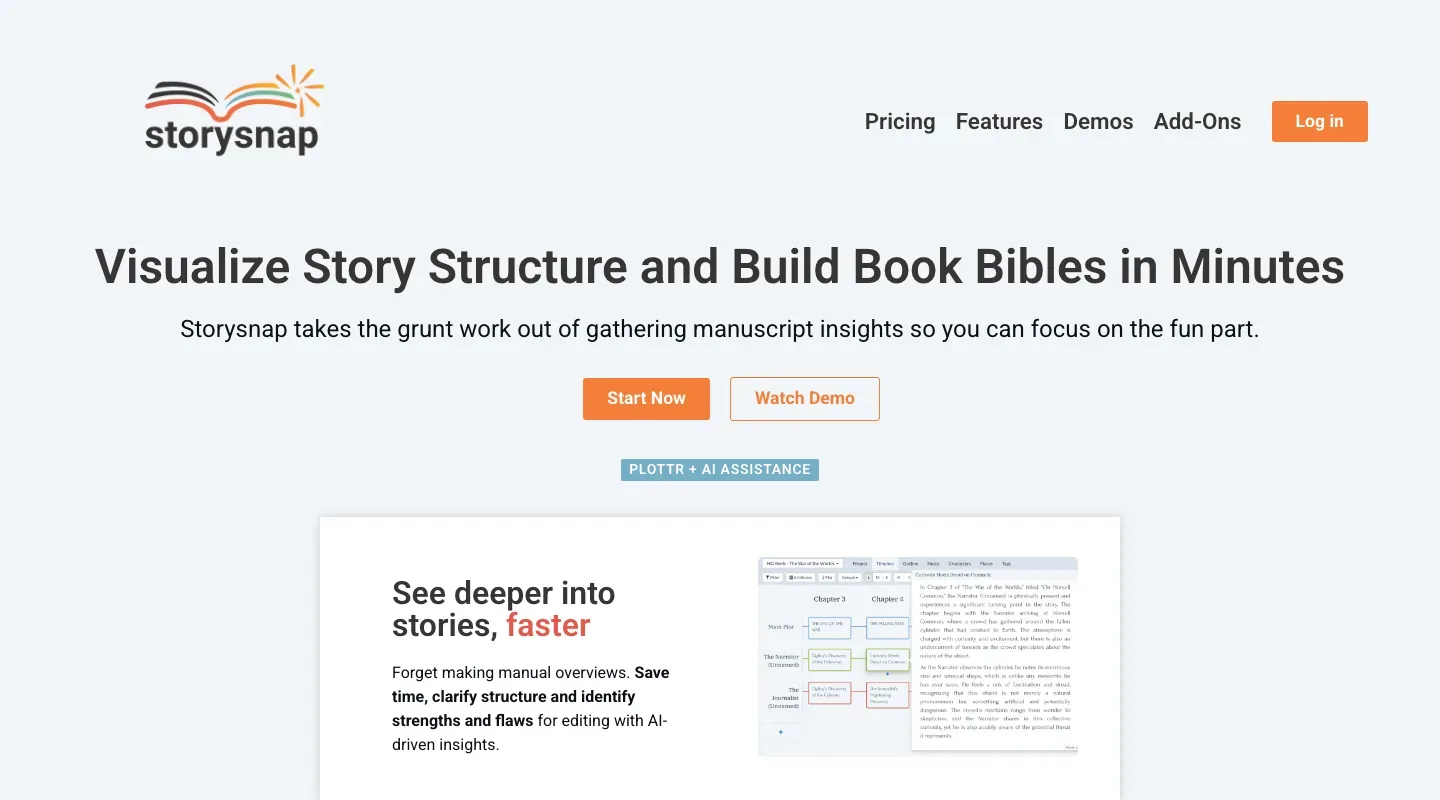
A complete story bible. Characters, locations, objects, world details, all extracted and organized from your text. Character profiles include physical descriptions, psychological backstory, relationship connections, and motivations.

Chapter-by-chapter summaries. Not a vague overview, but scene-level detail about what happens and who’s present.

Visual plotline maps. The main plot and individual character arcs, mapped visually so you can see how story threads weave together across the manuscript.

You can export all of this as a Word document or, if you’re a Plottr user, import it directly into Plottr’s visual timeline format. Scene cards, character entries, and plotline data all carry over.

For series writers, this is where the tool really earns its keep. Upload all five books in your fantasy series, and suddenly you have a unified story bible that tracks continuity across every volume. That character who appeared briefly in book two and became central in book four? Now you can trace that arc without rereading everything. (My future self thanks the universe for this.)

The AI Beta Reader

The second major feature is the virtual beta reader, and it targets a completely different pain point.

You describe your target audience (genre, age group, reading preferences), and Storysnap generates up to five simultaneous beta reads from different AI personas. Each persona is tuned to a different reader demographic, so you might get feedback from the perspective of a voracious romance reader alongside a more casual literary fiction fan.

The feedback covers plot structure, pacing, character development, and genre expectations. It won’t replicate the emotional gut-punch of a human reader ugly-crying at your climax, but it can surface structural patterns that are hard to see when you’re standing inside the story.

A professional manuscript critique runs anywhere from $500 to $800 and typically takes three to four months. Storysnap’s beta reader delivers structured feedback in minutes. It’s not a replacement for human readers (no AI is, and anyone who tells you otherwise is selling something). But as a first pass before you invest that kind of time and money? It can flag the big-picture problems worth addressing early.

There’s a free trial for the beta reader feature, so you can test it before spending any credits.

The Add-On Marketplace

Beyond the core story bible and beta reader, Storysnap offers an add-on marketplace with tools for chapter-by-chapter editing flags (inconsistencies, plot holes, pacing issues, grammar problems), book blurb generation, book club questions, Amazon sales descriptions, and more.

Third-party developers can create add-on prompt packages too. Writing coaches and editors could build specialized analysis tools on top of Storysnap’s infrastructure, which is a cool idea if the marketplace actually gets traction.

Working Backwards

Most AI writing tools point forward. They help you brainstorm, outline, draft, and generate. The assumption is always that you’re building something from scratch.

Storysnap points backward. It assumes you’ve already done the creative work and need help making sense of what you made. I love that.

The AI isn’t generating fiction. It’s reading fiction and extracting structure from it. The prompts are built specifically for how fiction works, because a novel isn’t a business report. Characters develop. Subplots emerge and resolve. Themes thread through scenes that may be hundreds of pages apart. Generic AI document processing misses all of that. Storysnap’s fiction-specific approach is what makes the output genuinely useful rather than just… superficially impressive.

Cameron’s philosophy on this is “tools, not toys.” Storysnap doesn’t try to be your co-author. It’s more like a very fast, very thorough research assistant who read your book and took meticulous notes.

What You Should Know Before Buying Credits

It’s a credit-based system, not a subscription. One credit equals one manuscript upload. Credits start at $12 each and drop to $9 if you buy ten at once. They never expire, which is nice. But iterative analysis gets expensive. If you upload, revise your manuscript, and want to re-upload for fresh analysis, that’s another credit.

It’s for finished manuscripts. If you’re still drafting, this isn’t the tool for you yet. Storysnap needs a complete (or near-complete) book to analyze. Incomplete drafts will produce incomplete results.

Character detection isn’t perfect. The AI sometimes has trouble distinguishing between a character who’s physically present in a scene and one who’s merely mentioned in conversation. It also tends to focus on main characters, so secondary character tracking may have gaps.

It won’t write for you. Storysnap has no editor, no drafting tools, no prose generation features. It reads and analyzes. If you want AI that helps you write, look elsewhere. If you want AI that helps you understand what you’ve already written, this is built for exactly that.

It’s also web-only (no desktop or mobile apps), so you’ll need a browser. On the privacy front, Storysnap states that it never trains its AI on uploaded work. Your words remain yours.

Who This Is For

If you’re a pantser who wants organizational structure without changing how you draft, Storysnap meets you where you are. If you have a backlist of books with no story bibles, it can build them in minutes instead of weeks. Series writers dealing with continuity headaches across multiple volumes will probably get the most value per credit.

Nothing else on the market does quite the same thing. Most tools want to help you write. This one just wants to help you remember what you already wrote. And that’s a problem I didn’t even know I needed solved until I saw it working.

Similar Tools