
Update — April 5, 2026
OpenAI is shutting Sora down. The app and website close on April 26, 2026, with the API following on September 24. If you have videos saved in Sora, download them now. All data will be permanently deleted after the shutdown. Read OpenAI’s full FAQ on the discontinuation.
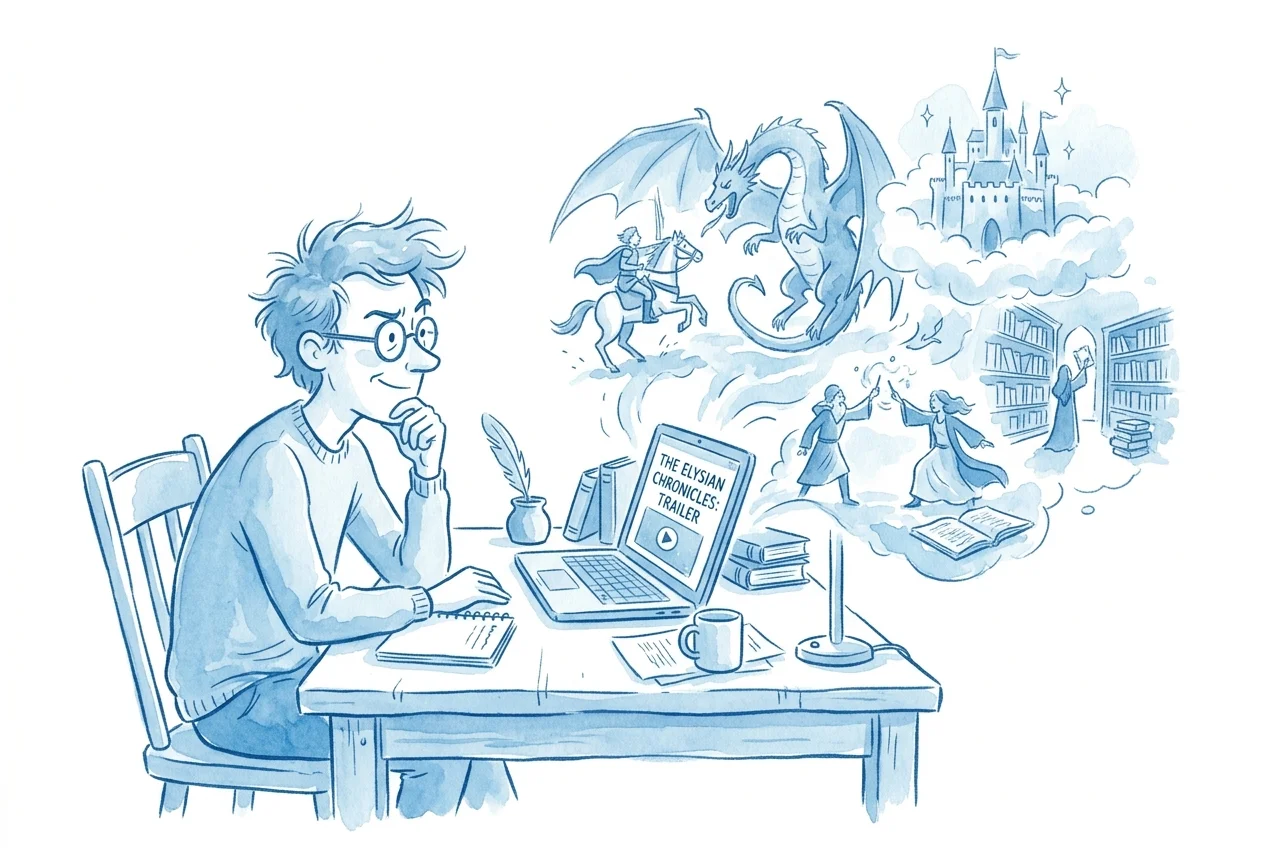
I have a confession. I’ve always thought book trailers were kind of silly.
Not the concept. The execution. Because unless you had a few thousand dollars and a friend who went to film school, what you ended up with was stock footage of someone walking through a field set to royalty-free piano music, with your title in Cinzel font fading in at the end. It looked like an insurance commercial that accidentally wandered into BookTok.
But I’ve been watching what people are making with Sora 2, and… I’m starting to change my mind.
The tool, briefly
OpenAI published a safety overview for Sora 2 yesterday, and buried inside the corporate responsibility language is actually a useful picture of what the tool can do now. You can generate video from text prompts. You can upload an image (say, your book cover or a character concept) and turn it into a video clip. It handles audio. And it’s good enough now that the output looks like something you’d actually want people to see. (Wild, right?)
The safety stuff is worth knowing about, too. Every Sora video gets watermarked (both visible and invisible C2PA metadata), there are guardrails around using real people’s likenesses, and they’ve built a consent system for anyone whose face appears. This matters for authors more than you might expect.
Why this is actually interesting for indie publishing
Book marketing is almost entirely visual now. Your cover is visual. Your social posts are visual. Reels and TikToks are video. The authors who are selling books consistently are the ones who figured out how to show up in those formats, even if they’d rather just be writing. (Same, friends. Same.)
Video has always been the hardest format for indie authors to crack because the production cost was wildly disproportionate to the return. A $2,000 book trailer for a $4.99 ebook is a terrible bet. So most authors either skipped video entirely or made something that actively hurt their brand.
Sora 2 changes that math. Not because it’s free (it’s not, you need a ChatGPT Plus or Pro subscription), but because it drops the cost of a decent 20-second book trailer from “small freelancer budget” to “I spent an hour on Saturday afternoon.”
Think about what you could do with this.
- A moody, atmospheric clip for your dark romance series that actually looks like a movie teaser
- A quick character reveal for a fantasy launch
- Short video ads for BookBub or Facebook that aren’t just a static cover with a zoom effect
- A visual “mood board” trailer that captures the feeling of your book without trying to be a movie
None of these need to be perfect. They need to be good enough to stop someone mid-scroll. That bar is a lot lower than “cinematic masterpiece,” and Sora 2 can clear it.
The consent stuff matters more than you think
The likeness and consent features deserve attention, because there’s a version of this that could get ugly fast and OpenAI seems to be at least trying to head it off.
The “Characters” system lets you upload your own face and voice, then control who can use them and how. You can see every video anyone makes with your likeness and delete it. You can revoke access whenever you want. There are extra guardrails around putting you in embarrassing situations or altering your appearance.
Why should authors care? Because the flipside of “anyone can make video cheaply” is “anyone can make video of anyone cheaply.” If your headshot is on your Amazon author page (and it should be), someone could theoretically use it as a starting point for AI-generated video. The consent framework is OpenAI’s answer to that risk, at least within their own platform.
It’s not a complete solution. Someone determined to misuse your likeness could use other tools, or future tools, that don’t have these guardrails. But the fact that the biggest player in this space is building consent infrastructure from the beginning is a good sign. It sets expectations for the industry.
What I’d actually try
If I were launching a book next month, I’d take my cover art (or a custom illustration in the same style) and use Sora’s image-to-video feature to create a 10-15 second atmospheric clip. Not telling the whole story. Just evoking a feeling. Rain on a window. A hand turning a page. A city skyline at dusk. A shadow moving through a doorway. Whatever lives in the emotional world of the book.
Then I’d use that as a Reel, a TikTok, a pin, and a pre-roll for my newsletter signup page. One afternoon of work, five pieces of content. Not bad for a Saturday spent in pajamas with Mochi on my lap.
Would it convert? I genuinely don’t know. But I know it would look better than what most indie authors are posting right now, and in a feed-based world, looking better is half the battle.
The part that’s still weird
AI video is still in uncanny valley territory sometimes. Hands do strange things. Physics gets creative. If you prompt “a woman reading a book in a coffee shop,” you might get six fingers and a latte that defies gravity. (AI lattes are ambitious.)
For book trailers, this actually matters less than you’d think, because the best book trailers have always been more about mood than realism. You’re not trying to recreate a scene from your novel with actors. You’re trying to make someone feel something for fifteen seconds. Abstract and slightly dreamlike? That’s a feature, not a bug.
The moment you try to show recognizable characters or specific scenes, though, the seams start showing. The more literal you go, the worse it looks. My advice? Stay impressionistic. Let the reader’s imagination do the heavy lifting, same as it does with your actual book.
One more thing
OpenAI mentioned that Sora blocks attempts to generate music that imitates living artists or existing works. I’m flagging this because the temptation to prompt “make me a trailer with music that sounds like the Bridgerton soundtrack” is going to be strong. Don’t. Use the generated audio or license something separately. The last thing your launch needs is a copyright claim on your promo video.
Sora 2 won’t write your book for you (different tools for that conversation), but it might finally make book trailers worth doing. For a community that’s been told for years to “get on video” without being given affordable ways to do it… well, now you’ve got one.
Sources
- Creating with Sora Safely, OpenAI’s safety and feature overview for Sora 2, including C2PA watermarking, consent-based likeness controls, and content moderation details