
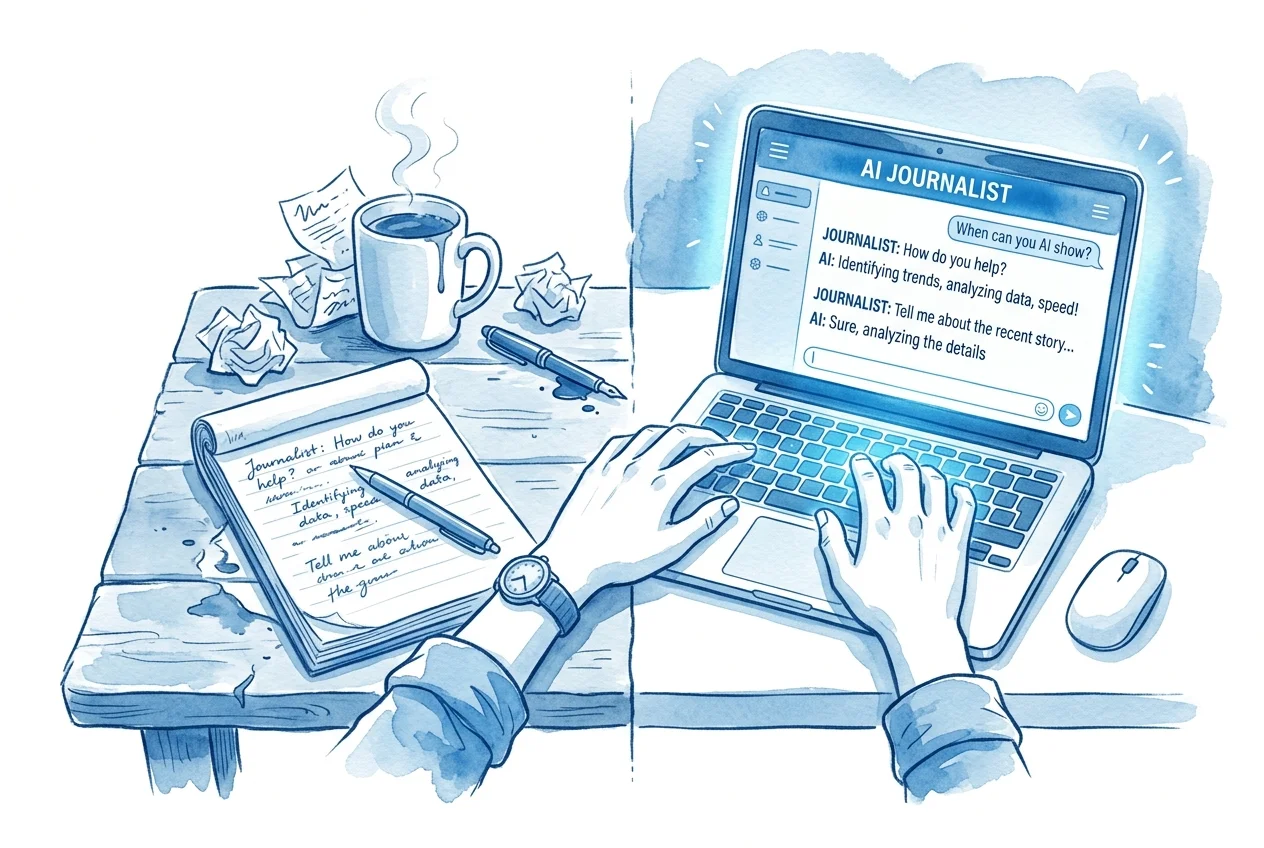
Five tech reporters. Five completely different AI workflows. And every single one of them is asking the same question you’re asking right now. Maxwell Zeff’s piece in Wired this week dropped this lineup and I haven’t been able to stop thinking about it.
Alex Heath dictates scoops to Claude and lets it write his first drafts. Jasmine Sun uses Claude as an editor with strict instructions to never write a sentence for her. Casey Newton is rethinking what his readers actually pay him for. Taylor Lorenz uses AI for her business but won’t let it near her actual writing. Kevin Roose built a team of Claude agents to edit his book but still writes every word himself.
Every one of these workflows maps onto conversations I have with authors constantly.
The Rewrite Desk Is Back
Several journalists told Zeff that Heath’s workflow reminded them of the old newspaper rewrite desk. Reporters in the field would phone in their notes, and a writer at the newsroom would turn them into articles by morning. The reporter’s job was getting the story. Someone else handled making it readable.
Claude is now the rewrite desk.
Nobody accused those field reporters of being lazy for not personally typing their articles. The division of labor was the whole point. The reporter did what only a reporter could do (be there, ask the right questions) and the desk handled the mechanical work of turning raw material into publishable prose.
For authors, the equivalent looks something like this. You do the thinking, the researching, the outlining, the creative decision-making. AI handles the part where you stare at a blank page trying to remember how paragraphs work ;)
The Jasmine Sun Approach
If Heath’s workflow is the most aggressive, Sun’s is the one I think authors should study.
She built a Claude editor with instructions that include this line. “You are not a co-writer. You cannot perceive. You don’t have experiences, sources, scenes, or emotions to draw from.”
That’s an editorial philosophy condensed into a prompt.
Sun told Zeff that Claude actually makes her work harder. It calls out lazy sections and floppy prose the way a good human editor would. And when people criticized her for “replacing” a human editor, she pointed out the thing critics always skip. Most independent writers can’t afford a human editor, so the real comparison is AI feedback versus no feedback at all.
Authors know this math. A developmental edit on a novel runs $1,500 to $5,000. Indie authors publishing multiple books a year aren’t paying that for every manuscript.
So you either self-edit (with all the blind spots that implies), swap with a critique partner if you can find a good one, pay up, or figure out something else. Claude following a carefully written set of editorial instructions is “something else.” It’s not a great human editor and Sun isn’t claiming it is. But it’s a massive upgrade over rereading your own draft for the fourth time, hoping you’ll somehow notice the structural problem you’ve been staring past since chapter three.
What Are People Actually Paying For?
Casey Newton said something every author needs to hear.
“If the value is in the information, not the writing, then I think people will care less that AI did most of the writing. If the value is in voice and opinion and argument and analysis, it seems like it’s cheap to use AI to do the whole thing.”
Nonfiction authors whose readers come for specific expertise and perspective? AI-generating your prose while you focus on ideas and research might be a perfectly reasonable workflow. Your readers want what you know. The sentences are a delivery mechanism.
Literary fiction where readers come specifically for how you arrange words on a page? Handing that to Claude defeats the entire purpose. The writing is the product.
Most authors fall somewhere in the middle. A romance author’s readers care about voice and emotional beats, but they also care about getting the next book before they forget the last one. A thriller writer’s readers want propulsive plotting, but they’ll bounce if the prose feels generic. You have to figure out which parts of your process are load-bearing and which parts are just… process.
Newton’s response was to shift toward more original reporting and less news analysis, because AI is getting good enough at analysis that it’s no longer his competitive edge. Smart move, honestly.
”I Feel Like I’m Cheating in a Way That Feels Amazing”
Heath said that. It made me laugh and wince at the same time.
Laugh because that’s exactly how it feels the first time AI genuinely saves you time on something you’ve been grinding through manually for years. Wince because “cheating” reveals how deeply we’ve internalized the idea that writing is supposed to be painful.
Nobody ever got bonus points for suffering through a first draft.
If you have something worth saying and a tool helps you say it faster so you can get back to the part of the work you’re actually good at, use the tool. That’s called working.
Heath was never in journalism because he loved constructing sentences. He loved getting scoops and making people feel smart. The writing was the part he tolerated to deliver the part he was great at. AI let him stop tolerating and start enjoying. I don’t see a victim in that story.
The Taylor Lorenz Position Is Also Fine
Lorenz isn’t using AI for writing or editing. She doesn’t trust it with sensitive materials and hasn’t found it useful for her actual craft. She likes writing.
That’s it. That’s a complete and valid position.
The conversation about AI and writing too often gets framed as a binary. You’re either all-in or you’re a luddite. The reporters in Zeff’s piece show it’s actually a spectrum, and your position on it should be determined by your own work and values, plus an honest look at what you’re good at and what you’d rather spend your time on.
If you love first-drafting and it comes easily to you, nobody should tell you you’re wasting time by not using AI for it. If you hate it and you’ve been grinding through it because you thought there was no alternative… maybe there’s an alternative now :)
The Google DeepMind Study Hiding in the Middle
Zeff mentions it almost in passing, but there’s a Google DeepMind study finding that lazy AI usage makes writing more homogeneous, less creative, with less voice and a more neutral stance.
This tracks with everything I’ve seen.
The key word is “lazy.”
Every journalist in this article who’s getting good results from AI has put serious work into their setup. Heath built detailed style instructions with his “10 commandments” of writing like himself. Sun wrote a small essay telling Claude exactly how to edit her work. Roose went even further and built an entire multi-agent editorial team with specialized roles.
Nobody in this article is typing “write me an article about tech news” into ChatGPT. They understood their own process well enough to teach it to a machine. That understanding took years to develop.
For authors, the takeaway is blunt. If you can’t articulate what makes your writing yours (your habits, your quirks, your structural instincts, which rules you follow and which ones you break on purpose) then AI will default to generic. You haven’t given it anything specific to work with. The writers getting the best results already knew themselves as writers before AI entered the picture.
Kevin Roose put it simply. “I am not under some romantic illusion that I possess a special, irreplaceable perspective. But what I am is a person, and I think that for now people, at least some people, like hearing from people.”
For now. He said for now. Honest in a way that makes a lot of writers uncomfortable. But honest is what we need right now more than comfortable.
Sources
- Meet the Tech Reporters Using AI to Help Write and Edit Their Stories — Maxwell Zeff’s Model Behavior newsletter in Wired, covering AI workflows of journalists including Alex Heath, Jasmine Sun, Casey Newton, Taylor Lorenz, and Kevin Roose
- Can LLM-Assisted Writing Help or Hurt Creativity? — Google DeepMind study on how AI usage affects writing homogeneity and creativity