
NotebookLM: The AI That Only Knows What You Tell It

By Morgan Paige Published February 27, 2026
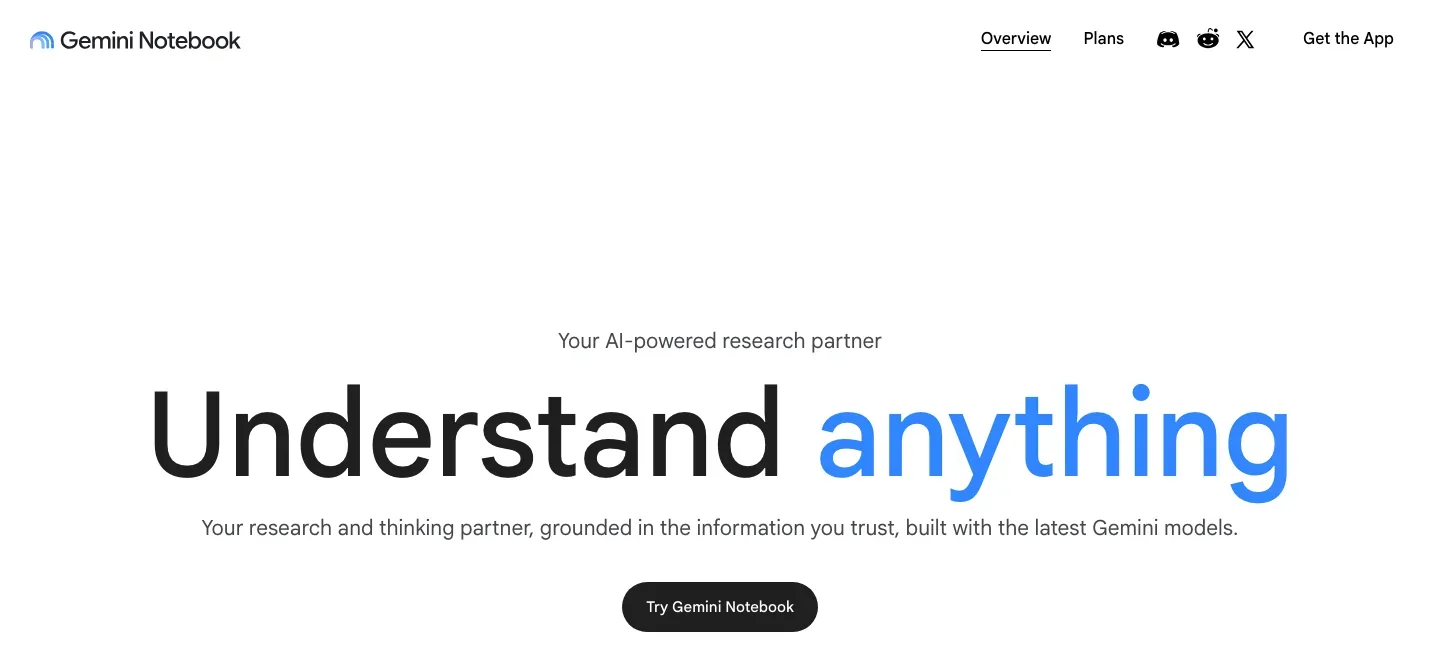
NotebookLM logo

You know that moment when you ask an AI about your own manuscript and it answers with something you definitely never wrote? Like, confidently? With details it clearly pulled out of thin air? You didn’t ask it to get creative. You asked about your worldbuilding notes. But the AI just couldn’t help itself.

NotebookLM was built by someone who found that just as frustrating as you do. Except that someone happened to work inside Google, and he happened to be one of the most respected nonfiction authors in America.

A Writer Inside the Machine

Steven Johnson has spent his career thinking about thinking. He’s the author of fourteen books (including Where Good Ideas Come From and the Edgar-winning The Infernal Machine), studied semiotics at Brown and English lit at Columbia, co-created three pioneering websites in the early internet era, hosted a PBS documentary series, wrote for Wired and The New York Times. The thread running through all of it was a fascination with what Howard Rheingold called “tools for thought,” software designed not just to record your ideas but to help you have better ones.

In the summer of 2022, Google Labs reached out to Johnson with a question. Would he be interested in helping build a new tool for thought designed around a language model?

He said yes. What followed was Project Tailwind, a prototype built in six weeks by a small team that included Johnson and product manager Raiza Martin. The core idea was deceptively simple. Instead of building another AI that pulls from the entire internet and confidently tells you things that may or may not be true, they’d build one that only knows what you tell it.

Johnson called it “source-grounded AI.” You upload your documents, your research, your notes. The AI reads them. Every answer it gives you is anchored to that material. When you leave the conversation, the AI forgets everything. Your documents go into the model’s short-term memory, not its training data. Nothing is retained. Nothing is shared.

Project Tailwind was announced at Google I/O in May 2023. By late 2023, it had been renamed NotebookLM and opened to the public.

The AI That Stays in Its Lane

Most AI tools want to be everything to everyone. Ask them a question outside their knowledge and they’ll give you an answer anyway, wrapped in enough confidence to make you believe it.

NotebookLM does the opposite. It deliberately limits itself to the sources you provide. For authors, this constraint turns out to be the whole point.

Say you’re writing a historical novel set during the California Gold Rush. You’ve spent months gathering research. Primary source documents, academic papers, letters, newspaper clippings. You upload fifty of those sources into a NotebookLM notebook. Now you can ask questions like “What did miners typically eat in 1849?” or “Were there any women running businesses in Sacramento during this period?” and the answers come directly from your research, with inline citations pointing to the exact source.

It won’t hallucinate a mining camp that never existed. It won’t invent a historical figure. It can only work with what you’ve given it, and it tells you exactly where each answer came from. (Wild concept, I know.)

For nonfiction authors, this is kind of a superpower. Writing a book about the history of urban planning? Upload your entire research library and have a conversation with it. Ask it to find connections between sources, or what themes keep recurring, or whether you’ve written any notes about 19th-century sanitation policy. It synthesizes across your documents in seconds. Something that might take you hours of flipping through notebooks and PDFs.

Johnson used it exactly this way. He uploaded his personal “spark file,” a collection of notes spanning nearly twenty years, and started asking it open-ended questions about his own accumulated thinking. The tool wasn’t creating new ideas. It was helping him find the ones he’d already had. That’s a cool distinction.

What You Can Feed It

NotebookLM is pretty flexible about what you can feed it. PDFs, Google Docs, Google Slides, Word documents, plain text files, websites (via URL), YouTube videos (it imports the transcript), audio files (MP3, WAV), even images. Each source can hold up to 500,000 words or 200MB, and the free tier lets you include up to 50 sources per notebook.

You can create up to 100 notebooks on the free tier. That means a separate research environment for every book, every weird tangent you’re chasing at 2 AM. Each notebook is its own contained world.

Once your sources are loaded, NotebookLM generates a study guide with a table of contents and suggested questions, giving you a structured starting point into your own material. From there, you chat with it conversationally, asking follow-up questions that go deeper into specific topics. It suggests follow-up questions after each response, creating what Johnson describes as a “Socratic method of dialogue” with your own documents.

Audio Overviews: Your Research, as a Podcast

This is the feature that made NotebookLM go viral.

Audio Overviews take your uploaded sources and transform them into a ten to fifteen minute conversation between two AI-generated hosts. They don’t just read your documents aloud. They discuss them. They banter. They make connections between ideas. They occasionally get genuinely excited about a concept buried on page thirty-seven of a PDF you uploaded three weeks ago.

The effect is uncanny. You upload a stack of research about Victorian-era London, press a button, and ten minutes later two voices are having a lively, informed discussion about your material. Complete with the kind of “oh, that’s interesting” moments that happen in real podcast conversations. It sounds natural in a way that most AI-generated audio just… doesn’t.

For authors, the practical applications are kind of wild. Upload your outline and character notes before a writing session and listen to two people talk through your story’s themes while you make coffee. Upload competing research sources and hear the hosts work through the tensions between them. Upload your draft and let them discuss what’s working and what isn’t. (I’ve done this with outlines. It’s weirdly motivating.)

You can customize the tone (critique, debate, brief overview) and even join the conversation yourself, using your voice to ask the hosts to go deeper on a specific topic or explain something differently. Audio Overviews work in over 80 languages.

The free tier gives you three Audio Overviews per day, which is enough to experiment. If you find yourself reaching for this feature regularly (and you will), the Plus plan raises that to twenty.

The Honest Tradeoffs

NotebookLM’s greatest strength is also its most significant limitation. It only knows what you tell it.

It’s not a general-purpose AI assistant. You can’t ask it for recipe suggestions or to help you write a tweet. It won’t brainstorm baby names or explain quantum physics (unless you’ve uploaded a document about quantum physics). If you want a wide-ranging AI conversation partner, ChatGPT or Claude will serve you better. NotebookLM is a specialist, and it’s deliberately narrow.

It’s not a writing tool. There’s no manuscript editor, no chapter organizer, no word count tracker. You can’t draft your novel inside NotebookLM. It’s a research and thinking environment. Your actual writing still happens somewhere else, whether that’s Scrivener, Google Docs, or a notebook full of handwritten scrawl.

The free tier has real boundaries. Fifty queries per day sounds generous until you’re deep in a research session and realize you’ve been asking questions for two hours straight. The Plus plan (500 queries per day) is included with Google AI Pro at $19.99/month, which also gets you Gemini Advanced and 2TB of Google storage. Reasonable pricing, but it means NotebookLM’s best experience is bundled with a larger subscription rather than available standalone.

Web only. No desktop app, no mobile app. You need a browser and an internet connection. For authors who like to work offline or who prefer native apps, this is a friction point.

Google account required. You need a Google account to use it. For most people this is a non-issue, but if you have privacy concerns about Google’s ecosystem, it’s something to consider.

It can be slow with large notebooks. Audio Overviews for notebooks with many sources can take several minutes to generate. The chat interface is generally responsive, but complex queries across dozens of sources occasionally need a moment.

Who This Is For (and Who It Isn’t)

NotebookLM is ideal for authors who do serious research. If you’re writing historical fiction, narrative nonfiction, or any project that requires you to synthesize large amounts of source material, this tool was quite literally built for you. A nonfiction writer built it for himself, and it shows.

It’s also excellent for authors who are nervous about AI hallucination. Because NotebookLM can only work with your sources, the risk of it confidently inventing something false is dramatically lower than with general-purpose chatbots. Every claim comes with a citation. You can verify.

If you’re looking for a brainstorming partner that can riff on ideas beyond your existing material, or a tool that helps you generate prose, NotebookLM isn’t the right fit. It’s not trying to be those things.

But if you’ve never tried talking to your own research before? Give it a shot. Upload a few sources, ask a question, and see what comes back. There’s something genuinely satisfying about getting a sourced answer from your own accumulated notes in seconds instead of hours of flipping through PDFs and notebooks. (And honestly, the Audio Overviews alone are worth the free signup.)

Similar Tools