
Poe: One Subscription to Rule All Your AI Models

By Morgan Paige Published February 27, 2026
Poe logo

You’ve heard you should try Claude for character work. ChatGPT is apparently great for brainstorming. Gemini has that massive context window. Someone in your writing group swears by Mistral for poetry.

So you do the math. Twenty dollars a month here, twenty there, maybe another ten over there. Suddenly you’re spending more on AI subscriptions than you are on coffee, and you’re an author, so that’s saying something.

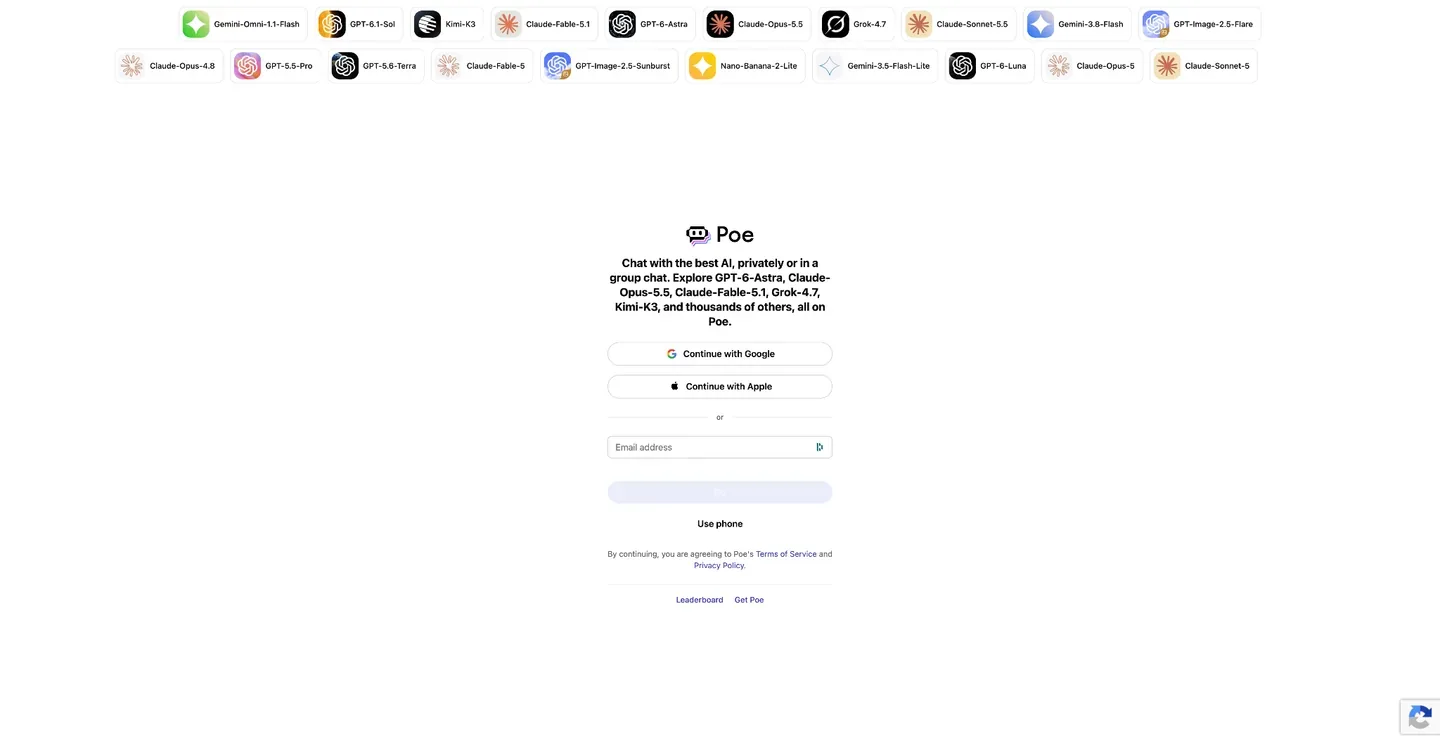
Poe (Platform for Open Exploration) takes all of those models and puts them behind a single login. One subscription, whole buffet. Think of it as the streaming bundle for AI.

The Guy Behind the Curtain

Adam D’Angelo has a thing for building platforms where information finds the right people. He was Facebook’s CTO back when the company was still scrappy enough to be interesting, then left to co-found Quora in 2008. When GPT-3 showed up and started answering questions instantly, he noticed something. People didn’t want to search for pre-written answers anymore. They wanted conversations.

He also noticed every AI company was building its own consumer app, its own billing, all of it duplicated across every company. His pitch was straightforward. Give users one platform where all these models can live.

“We’re more like a game console or an operating system, or a web browser,” he explained in 2023.

Poe launched in late 2022. By January 2024, Andreessen Horowitz had put $75 million behind the bet that the future of AI isn’t any single model, but the ability to hop between many of them.

What Poe Actually Does for Authors

At its simplest, Poe gives you a single interface to talk to GPT-4, Claude, Gemini, DeepSeek, Mistral, LLaMA, and dozens more. You sign in once and everything’s right there.

That alone is useful. But it’s not what makes Poe interesting.

Comparison without commitment. Working on a tricky scene? Send the same prompt to three different models and compare the results side by side. Maybe Claude nails the emotional nuance but GPT-4 gives you a better plot structure. Maybe Gemini catches a continuity issue the others missed because of that enormous context window. On any other platform, you’d need separate tabs and separate subscription fees for each one. On Poe, it’s one conversation.

Model-hopping for different tasks. You might start a brainstorming session with one model, switch to another for research (pulling in Poe’s web search bot to check facts), then bring in a third to draft the actual prose. Each model has strengths, and Poe lets you reach for the right one without breaking your flow.

Custom bots. Anyone can create a specialized bot by writing a set of instructions and choosing a base model. No coding required. Want a “Cozy Mystery Plot Generator” that knows the genre conventions? A “First Page Critic” that evaluates your opening against what agents say they’re looking for? Build these in minutes, or browse the million-plus custom bots other users have already created.

Poe Apps. A newer feature that lets users build small AI-powered applications inside the platform. These go beyond simple chatbots, allowing integration with multiple models and custom logic. For authors, this could mean a worldbuilding tool that cross-references your character sheets or a research assistant that synthesizes multiple sources into clean summaries.

The @-Mention Thing Is Actually Cool

Okay, this is the feature that made me stop scrolling and pay attention.

In a Poe conversation, you can @-mention any bot or model, and it joins the thread. Not in a separate window or a new conversation. Right there, in the same chat, with full context of everything that’s been said.

Picture this. You’re working through a complicated plot problem. You start with Claude, because it’s good at understanding character motivations. You lay out the situation, and Claude suggests three possible directions. Then you type @GPT-4 and ask it to evaluate which direction creates the most narrative tension. GPT-4 can see everything Claude said. It builds on that analysis and pushes back on one suggestion. Then it adds a twist you hadn’t considered. You @-mention a web search bot to verify that the historical detail your twist depends on is actually accurate.

Three models, one conversation, each one picking up where the last left off.

It’s like having a writing group where each member has a different specialty, except this group is available at 11 PM on a Tuesday and nobody needs a snack break. (Just me? Okay.)

The Creator Economy Angle

Poe isn’t just a place to use bots. It’s a place to build and sell them.

In October 2023, Poe launched creator monetization. If you build a bot that attracts users, you earn revenue two ways. There’s a share of subscription revenue when users upgrade because of your bot, and a per-message fee you can set yourself (added April 2024).

Sounds like a developer thing, but it has a practical consequence for authors. There’s a real financial incentive for people to build good specialized bots, which means the writing-focused corner of Poe’s ecosystem keeps growing. Browse the platform and you’ll find bots tuned for genre fiction, nonfiction structure, poetry critique, query letter feedback. Quality varies (as it does on any marketplace), but the best ones are genuinely useful.

The Honest Tradeoffs

You’re one layer removed from each model. When OpenAI releases a new feature for ChatGPT (like Projects or Canvas), it doesn’t automatically appear in Poe. You get the models themselves, but not always the native tools each company builds around them. Want ChatGPT’s Projects feature or Claude’s Artifacts panel? You still need those platforms directly.

Message limits exist, even on paid plans. The free tier gives you around 100 to 150 messages per day, with tighter limits on premium models. The $19.99 Premium plan expands that considerably, but you’re still working within a points system. Heavy users doing all-day writing sessions may bump into ceilings.

No manuscript management. Like every general-purpose chat AI, Poe doesn’t know what a chapter is. No outline view, no story bible. It’s a conversation platform, not a writing studio.

Quality varies on custom bots. With over a million custom bots, the range runs from brilliantly tuned to barely functional. Finding the good ones takes some browsing.

It requires internet. No offline mode. If you write at a cabin in the woods (respect), you’ll need a connection.

Who This Is Actually For

Poe is for authors who want to experiment with multiple AI models without paying for each one separately. If you’ve been curious about Claude but don’t want to commit to a subscription, or you’ve heard Gemini is good for long-context work but aren’t sure, Poe lets you try everything for the price of one membership.

It’s also a solid choice if your AI use varies day to day. Brainstorming Monday, research Wednesday, marketing copy Friday, something totally different Saturday. Being able to switch models based on the task is genuinely useful.

Less ideal if you want the deepest possible experience with a single model. ChatGPT’s native Projects feature, Claude’s Artifacts panel, Gemini’s integration with Google Workspace… you can only get those by going directly to those platforms. If you already know your model and use it heavily, a direct subscription will serve you better.

If you need a purpose-built writing tool with story structure and chapter management, NovelCrafter or Sudowrite are built for that. Poe is a conversation platform. A really good one with a lot of models behind it, but still a conversation platform.

Similar Tools