
Clio Books: The AI That Won't Write Your Book (and That's the Point)

By Morgan Paige Published February 26, 2026
Clio Books logo

You know you should write a book. Everyone tells you so. Your clients, your business partner who keeps forwarding you articles about thought leadership. Probably your mom, too. You’ve been meaning to do it for three years. Maybe five.

The problem isn’t that you don’t have anything to say. You could talk about your field for hours, and you regularly do, at conferences and client meetings, on podcasts and in casual conversations that accidentally turn into hour-long lectures. The problem is that “talk about it for hours” and “write a 60,000-word manuscript” are two completely different skills, and the second one requires months of lonely mornings with a blinking cursor.

Clio Books was built for exactly that gap. The distance between knowing your stuff and getting it onto paper. And its solution is disarmingly simple. Instead of asking you to write, it asks you to talk.

From Kitchen Table to 400 Books

Georgia Kirke didn’t start with an AI platform. She started with a phone and a transcript, plus a client who had expertise but no time to write.

Kirke has a background in English literature and international political communication. In 2015, she founded Write Business Results, a publishing consultancy that worked with entrepreneurs and business leaders who wanted to publish books but couldn’t (or wouldn’t) sit down and type them. The process she developed was manual and labor-intensive. Interview the client, transcribe their words, structure those transcripts into chapters, then edit the result into something publishable.

It worked. Over eight years, Write Business Results produced more than 100 business books. Over 50 of those hit #1 bestseller status on Amazon. Clients reported six-figure returns within a year of publication (not a bad ROI for talking into a microphone). Kirke doubled the business during the pandemic, when business leaders suddenly had both the time and the motivation to get their stories into print.

But the manual process had an obvious ceiling. Each book required dozens of hours of human interviewing and transcription, plus structural editing on top of that. The methodology was proven. It just couldn’t scale.

When large language models broke through in 2022 and 2023, Kirke saw her opening. The technology she’d always envisioned, an AI system that could do the structured interviewing and transcription she’d refined by hand, was finally possible. She partnered with thestartupfactory.tech and spent about a year building what became Clio Books, launching at the Frankfurt Book Fair in 2024.

The platform holds patents in both the U.S. and the U.K., and the core technology has a trademarked name: Speak-Your-Book. Which tells you just about everything you need to know about how it works.

How Speaking Becomes a Manuscript

Clio’s workflow has more in common with a structured interview than with a writing tool. You aren’t staring at a blank document. You’re having a guided conversation with a system that already knows the questions to ask.

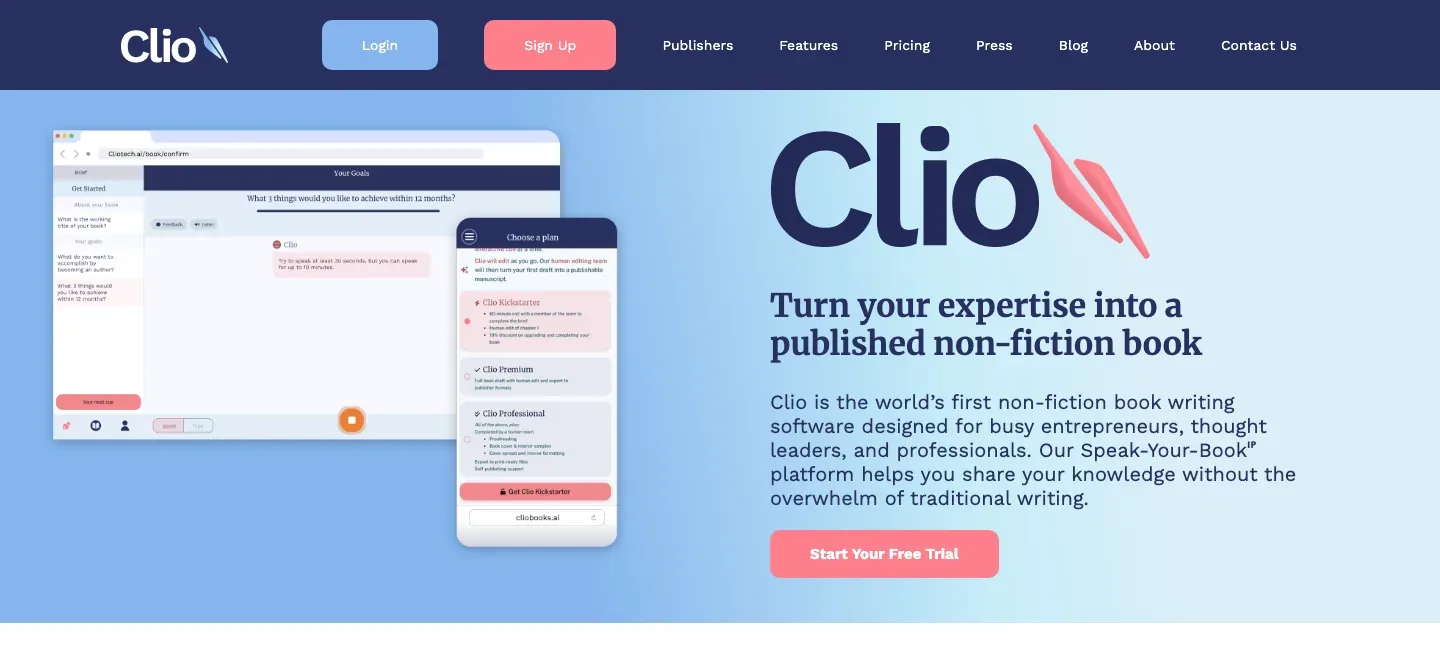
It starts with profiling. You fill out a questionnaire about your intended readers and goals, plus the topics you want to cover. The AI uses this to generate a synopsis and chapter titles, plus what Clio calls a “talking plan,” which is basically a sequence of prompts designed to draw out your knowledge in a logical order.

Then you talk. Each prompt takes under ten minutes of speaking, and the platform supports 57 languages. If you wander off-topic or start rambling (we’ve all been there), the system flags it and gently steers you back. The AI transcribes everything (speech-to-text) as you go, organizing your spoken responses into the chapter structure it generated earlier.

The target is a manuscript between 50,000 and 80,000 words, though the platform supports anything from 40,000 to 120,000. Kirke’s claim, backed by the hundreds of books her team produced manually, is that the speaking itself takes roughly ten hours total. Not ten hours in one sitting, but spread across sessions, each one guided by those tailored prompts.

What the AI does not do, and this is important, is generate content. It won’t summarize your ideas into something punchier or expand a bullet point into a paragraph. It’s definitely not going to look at your chapter on supply chain management and think, “I bet I can write something that sounds plausible here.” Every word of content comes from you, spoken aloud, transcribed, and organized. The AI provides the structure. You provide the substance.

Kirke is direct about this: “The software cannot and will not create content on somebody’s behalf, and that’s one of its many benefits. It’s all your own IP. It’s all your own knowledge.”

The Part Where Humans Show Up

Depending on which tier you choose, Clio pairs AI with professional human editors. The Premium package (£2,799) includes developmental editing and copy editing by real people. The Professional tier (£7,799) adds proofreading, a bespoke cover design, interior layout, print-ready files, and self-publishing support.

This is an unusual model for an AI writing platform. Most tools in this space position AI as the editor, or at least as a capable first pass at editing. Kirke takes the opposite view. AI is good at structuring and organizing, but understanding the nuances of human speech, catching the places where spoken language doesn’t translate cleanly to written prose, still requires a trained editor.

The result is something closer to a publishing service than a software subscription. You’re not paying monthly for access to a tool. You’re paying per book for a guided process that takes your spoken expertise and turns it into a finished product.

What Makes This Different

Every app on our site has AI. That’s the baseline. So what does Clio do that nothing else does?

The honest answer is that it solves a problem most AI writing tools don’t even acknowledge. The majority of AI writing tools start from the assumption that you’re a writer who wants help writing. Clio starts from the assumption that you’re an expert who doesn’t want to write at all, but who has a book’s worth of knowledge that could benefit from existing in print.

That voice-first approach isn’t a gimmick layered on top of a text editor. It’s the entire philosophy of the product, refined over 100 books before a single line of code was written. The methodology came first. The AI came second. That’s backward from how most AI startups work, and it shows in the product’s confidence about what it is and what it isn’t.

The per-book pricing model also aligns incentives in a way that subscriptions don’t. Clio succeeds when you produce a finished book. A subscription tool succeeds when you keep paying, whether or not you ever finish anything. For nonfiction authors who need accountability and structure more than they need features, that distinction matters.

Who This Is For (and Who It Isn’t)

Clio is built for nonfiction. If you write fiction, novels, short stories, creative nonfiction that relies on scene and voice, this tool has nothing for you. You won’t find worldbuilding features or character databases here. Clio is for business books, memoirs structured around professional expertise, how-to guides, and thought leadership titles.

You need to actually have the expertise. Clio won’t fill gaps in your knowledge. If you can talk confidently about your subject for ten hours, you’re the target audience. If you’re hoping the AI will help you figure out what to say, you’ll hit a wall quickly.

The pricing reflects a service, not a subscription. At £497 for an eBook package and £2,799 to £7,799 for a professionally edited and designed book, this is a significant investment. It makes sense for business owners and consultants who view a published book as a marketing asset with measurable ROI. It’s harder to justify if you’re writing for personal fulfillment on a tight budget.

It’s still early. Clio launched in 2024 and is building its user base. The methodology behind it has been validated across hundreds of books, but the AI-powered version of that methodology is newer. If you prefer tools with years of community feedback and extensive feature development, keep that in mind.

It’s web-only. No desktop app, no mobile app. You’ll need a browser and an internet connection for every session.

If you’re a business owner who’s been “meaning to write that book” for three years, Clio is the most direct path from your expertise to a finished manuscript. The methodology has eight years and over 100 books of proof behind it. You just have to be willing to talk about what you know. And if you’ve made it this far in your career, that’s probably the easy part ;)

Similar Tools