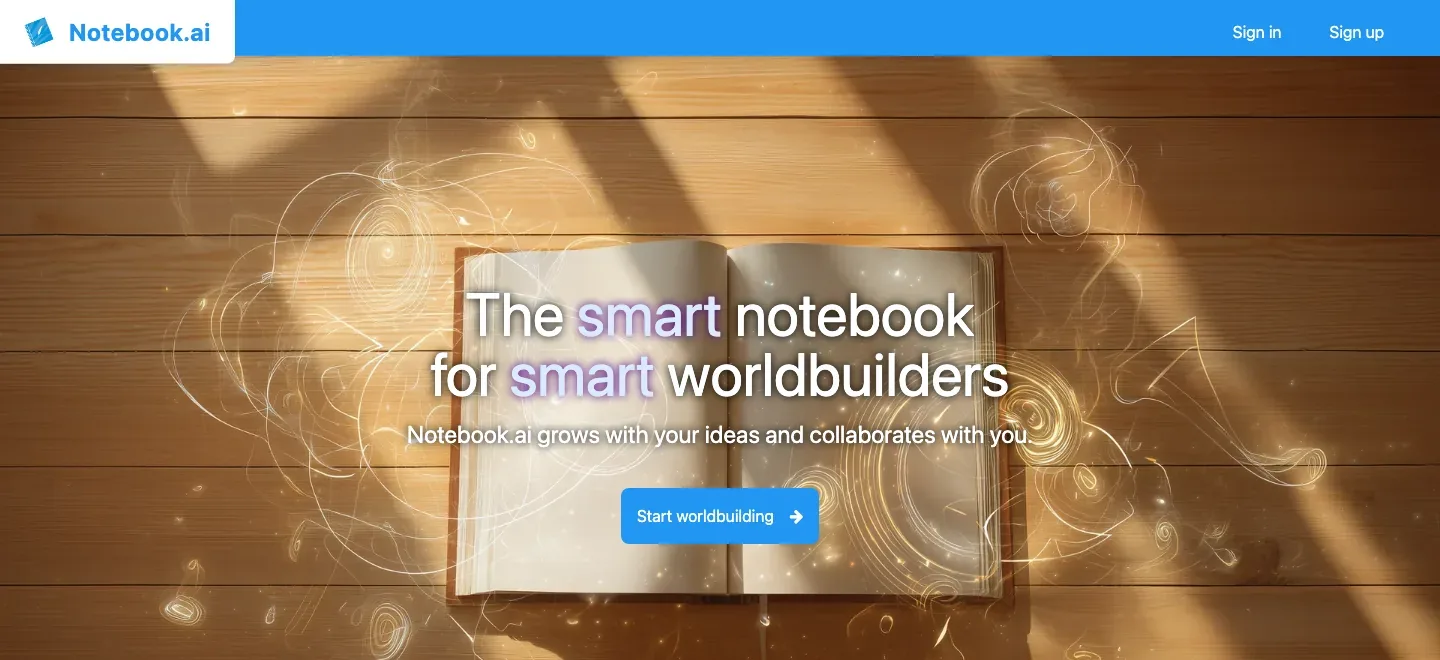

Notebook.ai: The Worldbuilding Tool That Asks Better Questions Than You Do

By Morgan Paige Published February 26, 2026
Notebook.ai

You’re 40,000 words into a novel and you can’t remember whether your protagonist’s hometown is in Oregon or Washington. Your antagonist’s sister was mentioned in chapter three, but did she have brown eyes or green? The magic system runs on moonlight. Or was it starlight? You wrote that detail somewhere. Probably. Maybe in a Google Doc. Or the Notes app on your phone at 1 AM. (We’ve all been there.)

Not writer’s block. Writer’s amnesia. And every fiction writer hits it eventually.

Andrew Brown knows that feeling well. He’s been doing NaNoWriMo for years, writing novels on deadline while juggling the sort of sprawling fictional worlds that generate exactly this kind of continuity chaos. And like a lot of writers who also happen to be programmers, he decided to do something about it.

From NaNoWriMo Frustration to 330,000 Users

Brown founded Indent Labs around 2015 with the goal of creating smarter tools for writers. He’d studied Computer Science at Missouri S&T and spent his off-hours writing poetry and fiction. He lived in both worlds, the creative and the technical, and kept noticing how poorly the tools in one served the needs of the other.

The first products out of Indent Labs were developer-facing APIs. Useful, maybe, but not the thing that kept Brown up at night. What kept him up at night was the notebook problem. The physical notebooks, the scattered Google Docs, the character sheets taped to the wall. Every worldbuilder he knew was essentially running a private wiki out of sticky notes and hope.

Notebook.ai launched in 2016 and found its audience immediately. Two thousand people signed up in the first 24 hours, with over five thousand more joining by the end of the first month. By 2020, the platform had more than 330,000 users building fictional worlds inside it. And that growth happened mostly through word of mouth. No big marketing budget, no venture capital war chest. Just a small operation built by someone who writes fiction and gets what fiction writers actually need.

What It Actually Does

Notebook.ai is a structured worldbuilding notebook. You create universes (up to five on the free tier, unlimited on Premium), and inside each universe you build pages for the things that make up your world. Characters, locations, items, creatures, magic systems, religions, governments, languages, and 20+ more categories beyond that.

Each page type comes with its own set of fields and writing prompts. A character page doesn’t just give you a blank text box. It asks about appearance, personality, history, relationships. A magic system page asks about visual effects, resource costs, moral alignment, and limitations. A location page prompts for climate, culture, landmarks, and local conflicts.

This is what separates Notebook.ai from, say, dumping all your worldbuilding into a Notion database. The templates are designed by someone who knows what questions worldbuilders need to answer. They’re specific enough to be useful but flexible enough that you won’t feel boxed in. Contribute as little or as much as you want to any field, and add custom fields (like “biggest weakness” for a character) if the built-in prompts don’t cover your needs.

There’s also a built-in document editor for actual prose writing. It’s not trying to be Scrivener or Google Docs, but it cross-references your worldbuilding pages, letting you quickly look up character details or location descriptions without switching tabs. Pretty nice when you’re mid-scene and suddenly can’t remember what your protagonist’s apartment looks like.

The Real Magic: Questions You Didn’t Think to Ask

Most worldbuilding tools give you a place to put information you’ve already figured out. Notebook.ai does something sneakier. It helps you figure out what you haven’t figured out yet.

Based on the content you’ve already created, the platform generates contextual questions across your dashboard. If your character has a name and a role but no hometown, it asks. If your magic system has rules but no limitations, it nudges you. Built a religion but haven’t considered its relationship to your world’s political structures? It connects those dots for you.

This might sound like a small thing.

It really isn’t. Ask any writer who’s gotten 200 pages into a fantasy novel only to realize they never worked out how their economy functions, or why two nations are at war. The gaps in your worldbuilding don’t announce themselves. They hide until the worst possible moment, usually when you’re on deadline and a beta reader circles a paragraph and writes “but why?” (I felt that in my soul.)

Notebook.ai’s question-based approach turns worldbuilding from a blank-canvas exercise into a guided conversation. You’re still making every creative decision, but you’ve got a collaborator who’s very good at asking the questions you forgot to ask yourself.

Relationships That Build Themselves

One of the more elegant features is how Notebook.ai handles connections between pages. When you link two characters as siblings, both character pages update automatically. Create a family tree and it builds itself as you add relationships. Assign a character to a group, and the group page reflects the new member.

This sounds simple until you’ve tried to maintain these relationships manually in a spreadsheet or a wiki. Dozens of characters, multiple factions, overlapping family trees, political alliances… keeping bidirectional links updated by hand is the kind of tedious work that makes you want to throw your laptop out a window. Or at least close the spreadsheet and go play video games instead.

The universe filtering feature works the same way. Writing book two in a series? Lock your view to that universe and everything else disappears. No scrolling past characters from your abandoned space opera to find the detective you need for your mystery novel.

Basil: Ethical Image Generation for Your World

In 2023, Notebook.ai added an image generation feature called Basil, and they actually put thought into how they did it.

Most AI image generators have a complicated relationship with their training data. Basil was built on a modified version of Stable Diffusion 2.1 (a diffusion model) with copyrighted works removed, then further fine-tuned on public domain photography and images collected with explicit opt-in consent for AI training. No Notebook.ai user content was used for training.

In practice, you select a worldbuilding page (a character, creature, location, whatever), choose a style, and Basil generates an image based on what you’ve already written about that page. No prompt engineering required. If you’ve described your character as a tall woman with silver hair and a scar across her left cheek, Basil reads those details and works from them. Pretty cool.

Free users get 100 image generations. Premium users get unlimited. All generated images include invisible watermarks identifying them as AI-created, and the platform publishes a transparency dashboard tracking quality metrics across different character demographics.

Is Basil going to replace a professional cover artist or concept illustrator? No. But for a writer who wants to see a rough visualization of their protagonist during the drafting process, or a game master who needs a quick portrait to show their players, it’s a solid addition. The kind of thoughtful feature that makes you trust the team behind the product.

The AI Analysis Side

Beyond image generation, Notebook.ai offers AI-powered story analysis for Premium subscribers. Upload or write a document in the platform and it will analyze readability across eight popular scales and measure emotional tone and sentiment (powered by IBM Watson). It also breaks down style metrics.

Important distinction here. This is analytical AI, not generative AI. Notebook.ai will not write your prose or generate plot ideas for you. It will tell you that your seventh chapter reads at a college level while the rest of your book reads at a ninth-grade level, or that the emotional sentiment around a particular character trends negative when you intended them to be sympathetic.

For writers who want AI as a measurement tool rather than a writing partner, that’s a meaningful difference.

Who This Is For (and Who Should Look Elsewhere)

Notebook.ai has found a devoted audience, and that audience tends to share a few traits. They’re building complex fictional worlds. They care about organization. They want structure without rigidity. And they’re often working on projects where continuity matters, whether that’s a long-running series, a tabletop RPG campaign, a shared universe, or all of the above.

Notebook.ai is a good fit if you…

  • Build detailed fictional worlds and need a system to track everything
  • Write series fiction where continuity across books is critical
  • Run tabletop RPG campaigns and want to share world details with players
  • Prefer guided prompts over blank pages when developing your world

Notebook.ai is probably not for you if you…

  • Want an AI writing assistant that generates or co-writes prose
  • Need a manuscript editor with grammar and style correction
  • Write standalone novels with simple, modern-day settings
  • Prefer offline desktop software (Notebook.ai is web-only)

There’s also a learning curve, though not a steep one. With 28 page types and dozens of fields per type, the depth of customization can feel overwhelming at first. The trick is to ignore most of it and start with just a character or two. The prompts will guide you deeper naturally.

Notebook.ai won’t help you draft chapters or polish prose. That’s not what it’s trying to do. What it will do is make sure that when you sit down to write chapter 27, you know exactly what color your protagonist’s eyes are and what her hometown smells like in autumn. You know why the magic system can heal wounds but can’t bring back the dead. You know because Notebook.ai asked you about it back in chapter four, when you still had time to figure it out.

For writers who build worlds, that’s not a nice-to-have. That’s the difference between a story that holds together and one that quietly falls apart in the places nobody thought to check.

Similar Tools