
NovelAI: The AI Writing Sandbox Born from a Privacy Scandal

By Morgan Paige Published February 26, 2026
NovelAI logo

NovelAI exists because a company made the spectacularly bad decision to read its users’ private stories without telling them.

In April 2021, users of AI Dungeon discovered that Latitude, the company behind it, had been letting human moderators read players’ private, unpublished fiction. No consent. No disclosure. Just people peeking at your creative work like it was their business. Latitude also rolled out content filters so aggressive they’d flag innocent phrases while breaking gameplay for everyone else. The Google Play rating cratered from 4.8 to 2.6 in weeks.

The trust was gone. And a small group of people from that community decided to build something different.

A Tool Born from Betrayal

NovelAI launched in June 2021, right in the wake of that meltdown. The team behind it, a company called Anlatan, wasn’t a well-funded startup with a pitch deck and a growth strategy. They were users. Writers and developers who’d been part of the AI Dungeon community and watched it implode over the exact issues they cared about most.

Anlatan is a small, fully remote team spread across the globe. Eren (known online as Kurumuz) serves as CEO and Head of Research, leading the AI model development. Virginia (Aini), a German artist with a decade of experience in gaming and community management, runs project management. The rest of the team covers backend, frontend, infrastructure, and a role you don’t see at most startups… “datasetting,” the careful curation of training data for fiction-specific AI models.

They built NovelAI on two principles that came directly from watching AI Dungeon burn down. Your stories should be encrypted so even the people running the platform can’t read them. And an AI writing sandbox should not tell fiction writers what they’re allowed to imagine.

Five years later, those principles still define everything about the tool.

What NovelAI Actually Does

Strip away the origin story and NovelAI is a generative co-writing tool. You write prose, the AI continues it. You steer it with context, settings, and a Lorebook system (their version of a story bible), and the AI picks up where you leave off, matching the tone and direction you’ve established.

It also has a Text Adventure mode where you give commands and the AI narrates what happens. Think choose-your-own-adventure running on a language model trained specifically for storytelling. (If you’re not immediately thinking about building a D&D campaign with this, we can’t be friends.)

What it is NOT is a grammar checker, an outlining tool, an editor, or a manuscript management system. No plot structure templates. No character arc tracking. If you want a polished writing suite that holds your hand through the process, NovelAI will confuse and frustrate you.

This is a sandbox. A playground for prose. You bring the story; it brings the generative muscle.

They Train Their Own Models

Most AI writing tools are wrappers around someone else’s language model. They connect to OpenAI’s GPT or Anthropic’s Claude, add a nice interface on top, and call it a product. Nothing wrong with that, but it means every tool using the same model produces fundamentally similar output.

NovelAI does something different. They train and fine-tune their own models, built on a proprietary dataset they call Nerdstash. These models exist for one purpose, and that purpose is generating fiction.

Their flagship fiction model is Erato, a 70-billion-parameter model based on Meta’s Llama 3, further trained on hundreds of billions of tokens of fiction-focused data. They also offer GLM-4.6, a 355-billion-parameter model by Zhipu AI (released on NovelAI in October 2025), with a context window that can hold roughly 28,000 tokens of your story in memory at once, with an additional 8,000 tokens of rollover. For users on the entry-level Tablet plan, there’s Kayra, a capable 13-billion-parameter model built entirely in-house.

Why should you care? Because a model trained specifically on fiction understands narrative differently than a general-purpose chatbot. Pacing, voice, dialogue rhythm, the way a scene builds tension before a reveal. A fiction-tuned model handles these with more nuance than a model designed to also write marketing emails and answer trivia questions.

The tradeoff is that NovelAI can’t tap into the latest GPT or Claude model the way a BYOK tool can. You’re limited to what Anlatan offers. When their models are good (and Erato and GLM-4.6 are genuinely good), this is a strength. When a competitor releases something remarkable, you’re waiting for Anlatan to catch up.

Encryption You Can Actually Trust

Remember the AI Dungeon disaster? NovelAI’s answer to that isn’t a privacy policy. It’s math.

Every story you write is encrypted in your browser using XSalsa20 (a stream cipher) before it ever reaches NovelAI’s servers. The encryption key is derived from your password through argon2 hashing. The stories stored on NovelAI’s servers are scrambled data that even Anlatan’s own staff cannot read. (I love this so much.)

During active generation, unencrypted portions of your story do travel to their servers so the AI can process them, but that data is transmitted over HTTPS and isn’t logged or stored.

This design has a real consequence, though. If you forget your password and reset it, your stories are gone. No recovery. No “contact support” option. The encryption is genuine, and genuine encryption means nobody has a back door. Not even the people who built it.

For writers working on sensitive material, or writers who just believe their creative work is nobody’s business, this level of privacy is rare in the AI writing space.

The Lorebook

NovelAI’s Lorebook is how you give the AI persistent memory about your story. You create entries for characters, locations, world rules, plot details, whatever you want the AI to remember. When certain keywords appear in the text, the relevant Lorebook entries get pulled into the AI’s context window automatically.

It’s a simpler system than what you’d find in NovelCrafter (which builds an entire structured database around your story world). The Lorebook is more like a set of reference cards the AI can peek at when it needs them. For writers who prefer a lighter touch, this works well. For writers managing epic fantasy series with dozens of named characters and interconnected plotlines, it may feel limited.

The Image Generation Side

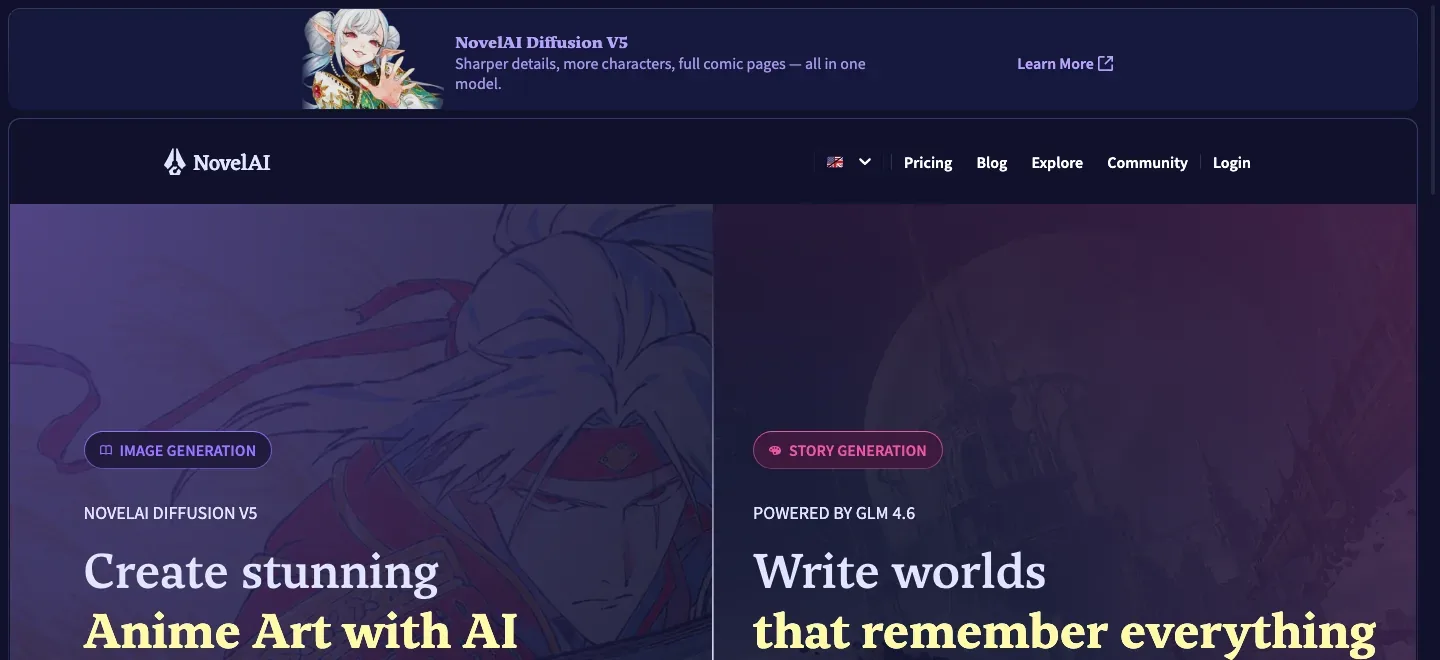
NovelAI also generates images, and they’re quite good if you’re into anime-style art. The platform produces roughly 4.8 million images per day across its user base, which tells you something about how popular this feature is. (That’s… a lot of anime.)

The image generation runs on NovelAI’s own custom diffusion models, with tools for inpainting, upscaling, and a “vibe transfer” feature that lets you guide the style of generated images. It’s focused squarely on anime and manga aesthetics. If you want photorealistic cover art or watercolor illustrations, look elsewhere.

For fiction writers, the practical use case is concept art. Character visualizations, scene compositions, maybe even a cover mockup or two. It’s a nice bonus bundled into a writing subscription rather than a standalone product you’d pay for separately.

Who This Is For (and Who It Isn’t)

NovelAI rewards a specific kind of writer. Someone who enjoys tinkering with tools and adjusting parameters, and who values creative freedom and privacy above guided workflows.

It has a real learning curve. The interface offers sampling parameters, context settings, prompt engineering options, and configuration choices that can feel overwhelming if you’re coming from a simpler tool. Getting consistently good prose output requires understanding how the models work and investing time in your Lorebook. This is not a “type a prompt and get a chapter” experience.

NovelAI is a good fit if you write fiction and want AI trained specifically for fiction, if you care about privacy and want real encryption (not just a policy document), if you enjoy a sandbox approach where you control the generation process, and if you’re comfortable with a tool that has knobs to turn and settings to learn.

It’s probably not for you if you want an all-in-one writing suite with outlining and editing tools, if you need something that works out of the box with minimal setup, if you write primarily nonfiction or business content, or if you prefer a polished, guided experience over a flexible sandbox.

A Sandbox with Principles

NovelAI isn’t the easiest AI writing tool to learn. It won’t hold your hand or outline your novel for you.

But the team behind it watched another platform betray its users and decided to do better. They built real encryption into the architecture and trained their own fiction-specific models so writers would have a private, uncensored creative space. That kind of commitment isn’t marketing copy. It’s in the code.

Similar Tools