
You know the drill by now.
You’re drafting in Google Docs or Word, you hit a wall on a scene, so you open ChatGPT in another tab. Paste in three paragraphs of context and explain what you’re going for, then ask for help. The AI gives you something decent. You copy the useful parts, paste them back into your manuscript, and… the voice doesn’t match. Back to the chat. More context. Try again. Copy, paste, adjust, repeat.
It works. Like a screwdriver works as a pry bar when you don’t have better options.
Stew Fortier watched writers go through this cycle for years. He had an unusual vantage point, having spent time at one of the world’s top AI research labs before running a community where thousands of writers helped each other get better. He understood what AI could do. He understood what writers actually needed. And the gap kept bugging him.
From Writing Community to AI Editor
Fortier’s path to building a writing tool started at the Allen Institute for Artificial Intelligence (AI2), one of the most respected AI research organizations in the country. He joined as CTO in Residence and spun out WellSaid Labs, a text-to-speech company, while he was there.
Then he went in an unexpected direction. Instead of building another AI company, he co-founded Foster, a community platform where writers helped each other through structured peer feedback. Foster went through Y Combinator and grew into a genuine home for serious writers. Fortier spent years inside that community listening to what writers struggled with and where the creative process kept breaking down.
Two patterns kept showing up. First, writing is iterative. Nobody produces a finished piece in one pass. You draft, rethink, revise, restructure, and polish. Second, the AI tools available to writers treated writing as something you could fully delegate with the right prompt. “Most of the AI writing products built over the past two years do little to solve these problems,” Fortier wrote when announcing his next company. “They treat writing like a ‘one-shot’ activity that should be fully delegated to AI.”
He teamed up with Stefan Li, a software engineer who’d built products at Meta, Walmart Labs, and Sony, and who had specific experience building advanced document editors. Together, working from Brooklyn, they started Type.ai. Y Combinator backed them again (Winter 2023 batch), and they raised a $2.8 million pre-seed round. The idea was simple. Stop making writers jump between a chat window and a document. Put the AI inside the document itself.
A Document Editor, Not a Chatbot
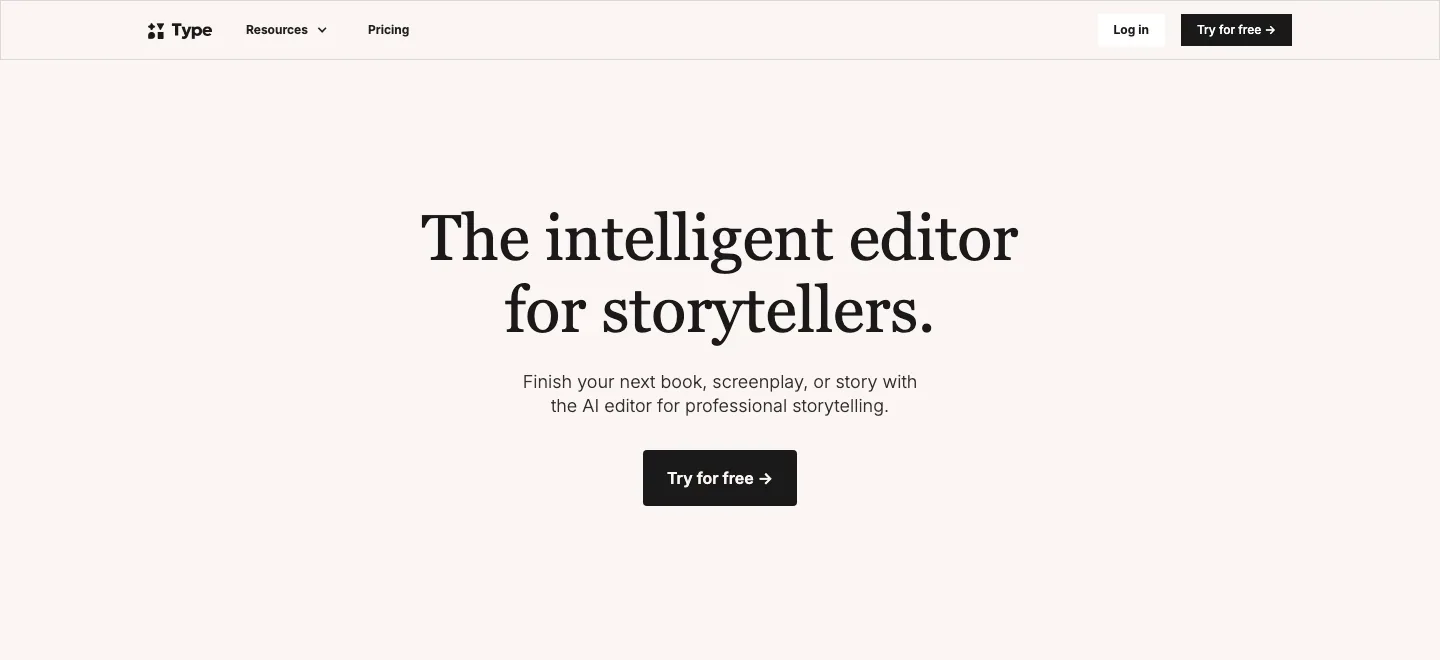
Type.ai is a document editor. Not a chatbot with an export button, and not a template engine that fills in blanks. It’s a real writing environment, closer to Google Docs than to ChatGPT, where AI is woven into the surface where you actually work.
The core interaction works like this. You’re writing, you need help. Maybe you’ve outlined a scene but want the AI to draft it. Maybe a paragraph exists but the tone is wrong, or you need a transition between two sections that aren’t connecting. You press / to open the command menu, type what you want, and the AI makes changes directly in your document. Not in a separate window. Right there, in the text, where you can see exactly what it’s proposing.
You get a preview before anything changes. Accept what works, reject what doesn’t. Tweak the prompt and try again. The document stays yours the entire time.
Fortier describes the experience as sculpting. “Writing in Type is kind of like sculpting,” he’s written. “You can have the AI generate high-quality text that you can then easily refine to better fit your voice and intention.” I like that framing. You’re not asking a machine to produce a finished piece. You’re shaping rough material into something that sounds like you.
There’s also a sidebar chat (called Type Chat) that works like a conversation with an AI that has read your document. You can brainstorm, ask questions about what you’ve written, dig into structural problems, or just think out loud about where a scene is going. When the chat produces text you want to use, you push it into the document directly instead of copying and pasting. Small detail, but that kind of friction reduction adds up across a long writing session. (Trust me on this. I’ve lost entire paragraphs in the copy-paste shuffle.)
The Knowledge Vault
One feature matters more for authors than almost any other kind of user.
Type.ai includes a Knowledge Vault where you can upload reference documents. Character bibles, worldbuilding notes, research material, outlines, previous chapters. The AI draws on everything in the Vault when it responds to your requests, which means it stays grounded in the world you’ve already built instead of inventing things from scratch.
For authors working on anything longer than a short story, this is the line between an AI that helps and an AI that creates more problems than it solves. Without context, AI suggestions drift. Names change and continuity falls apart. Rules you carefully established get broken two chapters later. With the Knowledge Vault loaded, the AI has access to the same reference material you do, and its suggestions actually reflect that.
Tools like Bookwiz (with its Story Bible) and NovelCrafter (with its Codex) solve this same problem inside purpose-built fiction environments. Type.ai brings the concept into a general-purpose editor, which makes it useful for authors who also write nonfiction, newsletters, essays, or anything else that benefits from persistent context.
Choosing Your Model
Type.ai lets you pick which AI model to use. As of early 2026, the options include GPT-5 and Claude 4.5 Sonnet. All are included in the subscription. No API keys to manage. No separate billing dashboards. You just select the model that fits the task and write.
This is a genuine convenience. Different models have different strengths (Claude tends to produce more natural-sounding prose, while GPT models can be stronger at structured tasks), and having both available without extra setup lets you match the tool to the moment. I tend to reach for Claude when I’m working on voice-heavy stuff, but your mileage may vary ;)
Why In-Place Editing Matters
What separates Type.ai from most AI writing tools is a design decision about where the AI’s work shows up.
When you use ChatGPT or Claude directly to help with writing, the AI’s suggestions appear in a chat window. You read them in isolation, stripped of surrounding context, and decide whether they’re good enough to copy into your manuscript. That evaluation is harder than it sounds. A paragraph can look fine in a chat window and feel completely wrong once it’s sitting between your other paragraphs. The voice shifts. The rhythm breaks.
Type.ai’s in-place editing sidesteps this entirely. When the AI proposes changes, you see them inside your document, surrounded by the text that comes before and after. You evaluate suggestions against the actual texture of your prose. You catch voice mismatches immediately, before they become part of the manuscript.
For fiction writers, this matters way more than it might for someone drafting a business report. Novels live and die on voice consistency and sentence rhythm, on the way a character’s dialogue sits against the narration around it. Evaluating AI contributions in context rather than in a vacuum is a real advantage.
The Honest Tradeoffs
Type.ai is a young product from a small team. Y Combinator-backed with $2.8 million in pre-seed funding, which is real backing. But you should know the scale of the operation behind a tool you might build your next manuscript around.
It’s web-only. Desktop wrappers are available through WebCatalog for Mac and Windows, but these aren’t native applications. There are no iOS or Android apps. Offline mode is supported, which helps, but if you need a polished native desktop experience, this isn’t it yet.
The pricing is premium. $29 per month on a monthly plan. Annual billing brings it to $23 per month ($276 per year), and there’s a first-year promotional rate of $144 per year for new subscribers. A free tier exists for testing, but with limited AI usage. For comparison, Scrivener costs $49 once and Atticus costs $150 once. Type.ai’s ongoing subscription makes sense if you use the AI daily, less so if you write in occasional bursts.
AI usage has limits. Pro subscribers get significantly more capacity than free users, with an option to buy additional credits. If you’re deep in a revision pass and leaning heavily on AI assistance, pay attention to how quickly those credits go.
It’s not built specifically for fiction. There’s no chapter organization, no story bible, no character tracking, no plot boards. The Knowledge Vault provides some of that context, but authors who need structural scaffolding for their manuscripts will find deeper support in tools like NovelCrafter, Scrivener, or LivingWriter. Type.ai is a document editor that works well for writing. It’s not a novel-writing suite.
No collaboration features. If you work with a co-author or want to share a live document with your editor inside the tool, that’s not currently part of the platform.
Who Should Try It
Type.ai is for authors who’ve tried using ChatGPT or Claude to help with their writing and found the experience promising but clunky. Promising because the AI was genuinely helpful. Clunky because it lived in the wrong place.
If you’ve spent any time in the copy-paste loop (writing in one window, prompting in another, shuffling text back and forth), Type.ai exists to collapse that distance. The AI reads your document, proposes changes inside your document, and you evaluate those changes surrounded by your actual prose. Not in a chat thread you’ll close and forget.
The free tier gives you enough room to find out if the in-place approach clicks for you. Fair warning though, it might ruin chat-based AI writing for you entirely.